


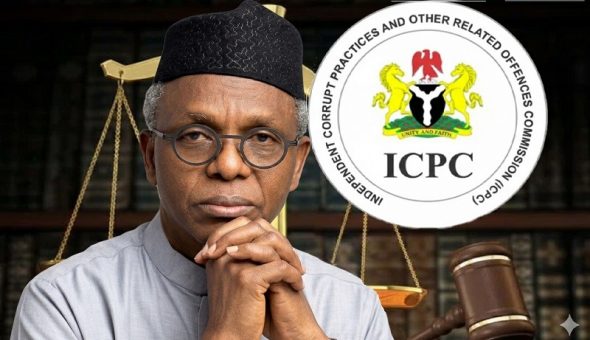
The Independent Corrupt Practices and Other Related Offences Commission (ICPC) has secured a 14-day remand order to detain former Kaduna State Governor, Nasir el-Rufai, over alleged corruption and abuse of office.
The anti-graft agency said a Magistrate Court in Bwari, Federal Capital Territory (FCT), granted the order on February 19, 2026, to enable it conclude investigations. The detention order is expected to lapse on March 5, 2026.
In court filings before the High Court of the FCT, where el-Rufai is challenging his detention as a violation of his fundamental human rights, the commission denied claims of arbitrary arrest or repression, insisting it acted within the law.
ICPC disclosed that during a search of el-Rufai’s residence at No. 12 Mambila Street, Aso Drive, Asokoro, Abuja, it recovered electronic magnetic devices allegedly capable of tapping telephone conversations, as well as sensitive security documents.
The commission said the search was conducted pursuant to a duly signed warrant and in the presence of the former governor’s wife, Hadiza Isma el-Rufai, and his son, Mohammed Bello el-Rufai.
According to the affidavit deposed to by ICPC litigation officer David Efuk, the former governor declined to grant investigators access to the retrieved equipment and opted to remain silent during questioning.
The agency further alleged that el-Rufai admitted during a national television interview to tapping the phone conversations of the National Security Adviser, Mallam Nuhu Ribadu.
It also claimed that the former governor is allegedly threatening potential prosecution witnesses, with one witness formally requesting protection from the commission.
ICPC said el-Rufai has questions to answer regarding several financial transactions, including:
€1.4 million in foreign currency withdrawals with unclear purpose.
180 suspicious payments totalling N2.15 billion from a Consolidated Revenue Account linked to Kaduna State’s internally generated revenue (IGR).
Transfers to undisclosed accounts amounting to N428.1 million.
Alleged diversion of public revenue and failure to remit funds into the Treasury Single Account (TSA).
Use of a debit card on a revenue bank account involving transactions of over N721.6 million.
The petition also alleged discrepancies in Kaduna State’s debt profile, including domestic loans of about N98.9 billion and foreign loans exceeding $7.3 billion contracted between 2015 and 2023.
ICPC further claimed that some projects undertaken during the administration were allegedly executed in violation of the Kaduna State Public Procurement Law, 2016, with several projects reportedly abandoned despite full payment.
The commission said it began preliminary investigations following a petition against the former two-term governor and retrieved documents from banks and government institutions.
After several unsuccessful attempts to invite el-Rufai through formal letters, ICPC said it received intelligence about his arrival at the Nnamdi Azikiwe International Airport on February 5, 2026, and sought assistance from the Department of State Services (DSS), though the attempt to arrest him there was unsuccessful.
The commission later served him an invitation letter at his residence, scheduling his appearance for February 13, 2026. At his lawyers’ request, the date was shifted to February 18.
Before then, he had honoured an invitation by the Economic and Financial Crimes Commission (EFCC), where he was detained and later granted administrative bail but reportedly failed to meet the conditions.
ICPC said he was subsequently handed over to its custody and remanded by court order.
In a sworn statement to the commission, el-Rufai described the investigation as politically motivated, linking it to his role in the opposition African Democratic Congress (ADC).
“I am a leading member of the African Democratic Congress (ADC), which I consider the only surviving opposition party in Nigeria, and that is the real reason I am being investigated,” he said.
The former governor stated that, on the advice of counsel, he would exercise his right to remain silent until arraigned in court.
“I will respond to any allegations only in a court of law. I do not believe these investigations amount to law enforcement. This is political persecution which only a judge can decide upon,” he added.
The commission maintained that it followed due process in inviting and detaining el-Rufai, stressing that it does not arbitrarily arrest or detain suspects.
It said it would file charges before the expiration of the remand order and urged the court to dismiss the fundamental rights enforcement suit, arguing that allowing the investigation to proceed uninterrupted is in the public interest.