


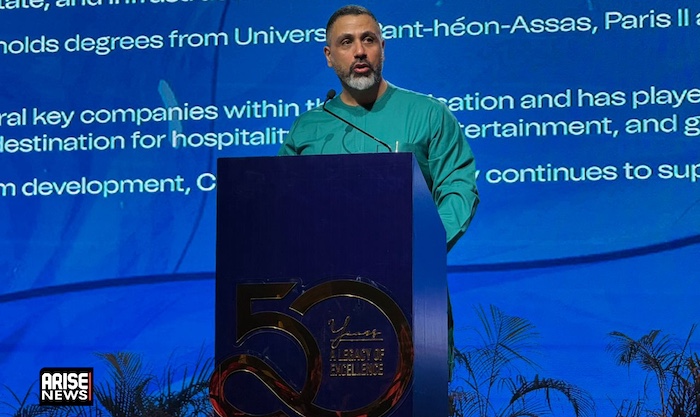
For two days, the atmosphere inside the Eko Convention Center in Lagos shifted far beyond the familiar rhythm of corporate conferences and ceremonial speeches. Under dim lighting and bright stage spotlights, policymakers, diplomats, business executives, creatives, hoteliers, aviation leaders, students, and tourism stakeholders gathered to confront a defining question: how can Africa reclaim its narrative and transform culture into economic power?
The occasion was the Africa Legacy Summit, organised to commemorate the 50th anniversary of Eko Hotels & Suites. Held under the theme, “Reimagining the Future of Culture in African Hospitality, Tourism and Travel,” the summit positioned Africa not as a continent waiting to be discovered, but as one already shaping global culture and influence.
The two-day event opened with the Nigerian national anthem and a cultural performance that immediately set the tone for conversations centred on identity, storytelling, tourism, and economic transformation.
What unfolded inside the convention hall felt less like a corporate anniversary and more like an ambitious attempt to redefine Africa’s place in global hospitality and tourism.
Among the dignitaries present were Lagos State Governor Babajide Sanwo-Olu, Pan-African scholar Patrick Lumumba, Honorary Consul General for Antigua and Barbuda to Nigeria Wallace Williams, Air Peace Chairman Allen Onyema, diplomats, government officials, traditional rulers, and business executives from across sectors.
Yet beyond the high-profile guests, another section of the hall drew attention — rows reserved specifically for students and young professionals. Their inclusion reflected one of the summit’s strongest recurring themes: the future of African tourism and hospitality belongs as much to the next generation as it does to established institutions.
Throughout the summit, speakers repeatedly emphasised mentorship, youth investment, and the importance of nurturing African talent locally rather than exporting it abroad.
A central message echoed across keynote speeches and panel discussions: Africa’s culture is not ornamental — it is economic infrastructure.
Chairman of Eko Hotels, Christopher Chagoury, captured that sentiment in one of the summit’s defining moments.
“We are not gathered here merely for a conference,” he said. “We are gathered to challenge an idea — the idea that culture is ornamental rather than foundational.”
According to Chagoury, Africa’s future in tourism lies in authenticity rather than imitation. He argued that African music, cuisine, fashion, festivals, storytelling, and hospitality are valuable assets capable of reshaping economies and elevating nations globally.
“The world is exhausted by imitation,” he stated. “What people seek now is authenticity, identity, meaning, connection — and Africa remains one of the richest reservoirs of all these.”
That argument was reinforced by Allen Onyema, who lamented Nigeria’s overdependence on crude oil while describing tourism as one of the country’s most underdeveloped economic sectors.
“Tourism is one area that has not been toured in Nigeria. We are so dependent on oil,” Onyema said.
Drawing comparisons with Singapore and Caribbean nations, the Air Peace chairman argued that Nigeria had overlooked opportunities capable of generating employment, prosperity, and global relevance.
He also criticised weak airport infrastructure, multiple security checkpoints, and poor transit systems, questioning how Nigeria hopes to position itself as a tourism destination under such conditions.
“There’s no hub infrastructure in these airports. How do you want to encourage tourism?” he asked.
Despite the criticism, Onyema strongly defended indigenous businesses and Nigeria’s aviation sector, urging citizens to stop undermining local institutions and instead promote the country’s strengths internationally.
The summit’s broader intellectual framing came from Ambassador Wallace Williams, who challenged African leaders to rethink culture as a tool of diplomacy and influence.
“For far too long, Africa’s image has been narrated away from Africa by outsiders,” Williams said.
He argued that despite stereotypes linking Africa with poverty and instability, the continent has shaped global music, fashion, cuisine, spirituality, literature, and entertainment for generations.
“Long before investors arrive, culture arrives,” he added, describing culture as one of Africa’s most powerful export tools.
Williams also highlighted Lagos as a reflection of Africa’s diversity and potential, describing the city as a place where visitors could experience “36 countries for the price of one.”
Managing Director of Eko Hotels, Ghassan Faddoul, stressed that the future of African hospitality would depend on innovation, sustainability, and young Africans bringing fresh ideas into the sector.
“As we mark 50 years, this is not only a celebration of the past, but a point of transition,” he said.
Faddoul emphasised environmental responsibility, technology, and artificial intelligence while insisting African hospitality businesses must remain rooted in culture and heritage.
By the second day, discussions shifted toward practical conversations around mentorship, standards, connected tourism experiences, and the role of technology in hospitality.
One of the standout moments came during a keynote session by global tourism strategist and Chief Executive Officer of Fura Collective, Stella Fubara, who urged African countries to become more deliberate about tourism development.
According to her, tourism extends far beyond hotels and travel, intersecting with infrastructure, healthcare, transportation, entertainment, and storytelling.
“You create the product, you create the narrative, and you speak the narrative in the voice of the person to whom you want to listen,” she said.
Drawing from her experience with Dubai’s tourism sector, Fubara explained that destinations succeed when they intentionally define their identity, target audiences strategically, and market themselves consistently on the global stage.
Her remarks reinforced one of the summit’s dominant conclusions: Africa already possesses the creativity, talent, and cultural richness required to compete globally, but stronger infrastructure, investment, coordination, and storytelling are needed to unlock its full tourism potential.
Beyond the speeches and policy debates, the summit itself embodied the vision it promoted. Cultural showcases, discussions on sustainability, tourism investment, Pan-African collaboration, and African storytelling filled the programme, while videos chronicling the evolution of Eko Hotels and its Corporate Social Responsibility initiatives highlighted how hospitality now extends beyond accommodation into experience, culture, and memory.
As the summit closed, one idea lingered above all else — African hospitality may no longer need foreign benchmarks for validation.
Perhaps, as Christopher Chagoury suggested, the benchmark itself is beginning to shift toward Africa.