


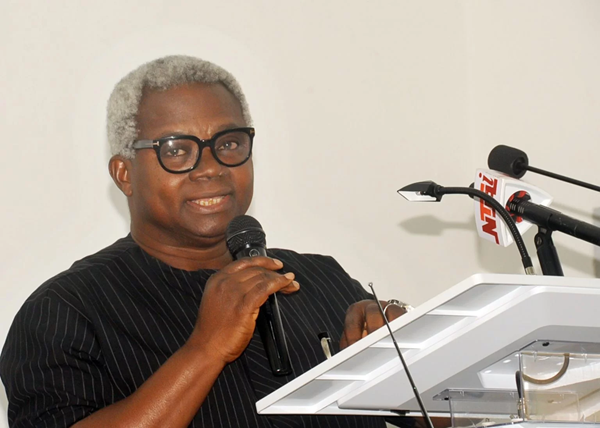
A founding member of the All Progressives Congress (APC), Osita Okechukwu, has rejected former Vice President Atiku Abubakar’s claim that Nigeria’s democracy is under threat, insisting that the real danger lies in Atiku’s long-standing presidential ambition rather than the administration of President Bola Ahmed Tinubu.
Okechukwu, a former Director-General of the Voice of Nigeria (VON), made the assertion in a statement issued on Sunday in Abuja, while reacting to Atiku’s recent warning about alleged moves by the Tinubu-led government to weaken opposition parties.
According to Okechukwu, a closer examination of Nigeria’s political trajectory would reveal that the erosion of democratic culture began when Atiku allegedly breached the long-standing rotation convention during the 2023 presidential election. He argued that this decision upset the political balance and significantly weakened the Peoples Democratic Party (PDP).
The APC chieftain further accused Atiku of attempting to repeat the same pattern ahead of the 2027 elections, this time within the African Democratic Congress (ADC). He described Atiku’s strategy as a “Kasuwa Ndollar” approach to the party’s presidential primaries, suggesting that financial influence could once again override internal democratic norms.
“Atiku Abubakar is, regrettably, one of the foremost culprits of this unforced error, which gravely cannibalised the PDP,” Okechukwu stated.
He added that Atiku’s financial strength places him at a disproportionate advantage over other aspirants within the ADC, warning that such imbalance could destabilise the party just as it did the PDP.
Okechukwu recalled that the rotation convention, introduced at the beginning of the Fourth Republic in 1999, was designed to promote unity, equity, and political stability by alternating presidential power between the North and South. He noted that Atiku himself benefitted from the arrangement, which paved the way for his emergence as Vice President in 1999.
He also cited the role of prominent northern leaders—such as Abubakar Rimi, Umaru Shinkafi, Adamu Ciroma, Bamanga Tukur, and Sola Saraki—who upheld the zoning principle and supported Chief Olusegun Obasanjo’s presidential bid following his release from detention during the Abacha era.
The former VON boss reminded Atiku of his walkout from the 2014 PDP National Convention, when he insisted it was the North’s turn to produce the President, a stance that eventually led to his defection to the APC.
“While one admits that my great party, the APC, has its own fault lines, is it not a calamity that the same Atiku Abubakar—widely acknowledged as the mastermind of PDP’s rotation breach—is now allegedly preparing a similar violation within the ADC?” Okechukwu queried.
He further questioned whether President Tinubu should also be blamed for what he described as a fresh breach of the zoning principle within the opposition.
Okechukwu concluded that Atiku’s assertion that the “systematic weakening of opposition platforms represents a grave danger to Nigeria’s democratic future” requires deeper self-examination and contextual honesty.
He also argued that Atiku would struggle to inherit former President Muhammadu Buhari’s estimated 12-million-vote northern base, noting that many voters in the region remain committed to the rotation principle and do not view Atiku as “Mai Gasakiya” (incorruptible), but rather as “Mai Kasuwa”—a label he said reflects public perception of Atiku’s political style.