


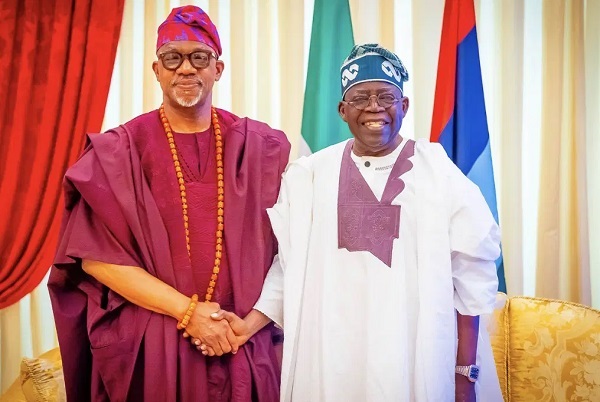
A growing political debate is emerging within the All Progressives Congress (APC) over what many observers describe as a strategic but controversial recalibration of power in the South-West political bloc loyal to President Bola Ahmed Tinubu.
At the centre of the conversation is Ogun State Governor Dapo Abiodun, whose increasing recognition within the region’s political hierarchy has sparked questions about loyalty, consistency and the future stability of the ruling party ahead of the 2027 elections.
Critics argue that the development reflects a troubling shift in the party’s internal reward system, where political ambiguity appears to be gaining acceptance over long-standing loyalty.
The controversy stems largely from events leading up to the 2023 presidential election, when political alignments within the APC became increasingly complex. Several politicians widely believed to have benefited from Tinubu’s political structure were perceived as hesitant in supporting his presidential ambition.
Among those frequently mentioned were former Osun State Governor Rauf Aregbesola and former presidential aide Femi Ojudu. Governor Abiodun was also linked to that political camp due to his perceived closeness to former Vice President Yemi Osinbajo, who contested against Tinubu during the APC presidential primaries.
Despite those divisions, some party loyalists maintained unwavering support for Tinubu’s candidacy. Former Ogun State Governor Gbenga Daniel and Senator Ibikunle Amosun were among figures credited with standing firmly behind the President during the tense political period.
Political analysts say the current prominence being accorded to Abiodun raises concerns among party faithful who believe consistency and loyalty should remain central values within the APC structure.
Observers also point to the irony of the governor’s evolving political standing, recalling the widely discussed “Eleyi” remark made during a political gathering in Abeokuta — a comment many interpreted as dismissive within the Yoruba sociopolitical context.
The situation has also revived memories of the political fallout between Tinubu and Aregbesola, a once-close ally whose relationship with the President eventually deteriorated, contributing to divisions within the APC in Osun State and tensions across the South-West.
For some stakeholders, the lesson from that experience should have reinforced the importance of rewarding dependable allies rather than encouraging shifting allegiances.
Analysts warn that elevating politicians perceived as politically flexible could create long-term risks for the APC by weakening trust within the party and encouraging opportunism among ambitious actors.
They further argue that loyal party members who spent years building grassroots political structures may become disillusioned if commitment is no longer viewed as a defining factor for political advancement.
In Ogun State, concerns are already growing over reports of internal disagreements and claims of exclusion among influential stakeholders. Recent tensions involving former Governor Gbenga Daniel and key party meetings have further highlighted unresolved cracks within the state chapter of the APC.
Political observers caution that unresolved factional disputes could weaken the party’s cohesion ahead of future elections and provide opportunities for opposition parties to gain ground.
Beyond Ogun State, the debate also raises broader questions about President Tinubu’s political legacy and the long-term survival of the South-West political structure he helped build over decades.
Many believe the strength of that legacy will depend not only on electoral victories but also on the stability, unity and internal trust within the APC after Tinubu’s tenure.
As political calculations ahead of 2027 gradually intensify, party stakeholders continue to debate whether the APC’s evolving power dynamics will strengthen the ruling party or deepen internal divisions that could threaten its future stability.