


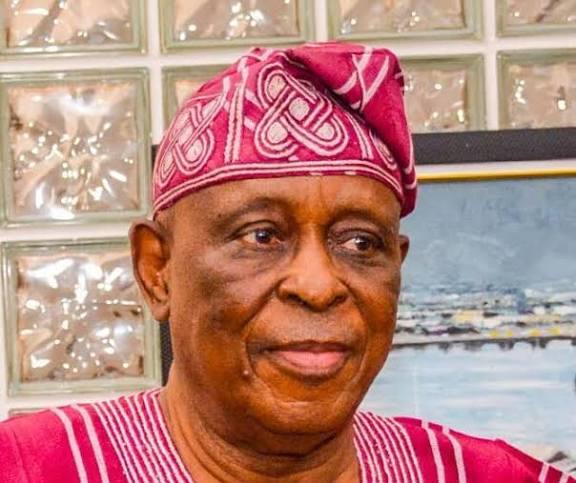
In Ogun State politics, few names carry the historical weight of Aremo Olusegun Osoba. A founding figure of progressive politics in the state and a former governor, Osoba occupies the moral high ground of elder statesmanship within the All Progressives Congress in Ogun. Yet, in the current configuration of power, that moral authority is increasingly questioned, not for what he has done, but for what he has chosen not to do.
As the most senior political figure in the Ogun APC, Osoba is expected to be the natural bridge between the present and the past, the reconciler capable of harmonising Governor Dapo Abiodun with his predecessors, notably Otunba Gbenga Daniel and Ibikunle Amosun. That bridge, however, has remained conspicuously unbuilt.
Instead of cohesion, Ogun APC has drifted into silos marked by cold wars, quiet exclusions, and calculated silences. For party loyalists, the lingering question is blunt. Why has Osoba not deployed his stature to bring all former governors to the same table. Or is the present fragmentation politically convenient.
Osoba today enjoys a level of proximity to the Government House that none of his peers does. This closeness has strengthened the perception that he is comfortable being the only former governor firmly within the governor’s inner circle. In politics, silence is rarely neutral. It is often read as alignment.
This posture contrasts sharply with his standing during previous administrations. Under Daniel and later Amosun, Osoba was largely absent from the orbit of state power. He neither hovered around Government House nor played any visible stabilising role within party structures. His distance then was defended as principled dissent. His closeness now is viewed as selective engagement.
The ideological thread is not hard to trace. Osoba openly leaned toward the presidential ambition of Yemi Osinbajo during the APC primaries. Governor Abiodun was widely perceived to share that orientation. That common outlook reinforced their political alignment. When that ambition failed at the national level, Ogun APC was left to manage deepening mistrust without a decisive elder intervention.
Recent events have further exposed these fault lines. Weeks ago, Amosun marked his birthday at Ake Pavilion. Party members were reportedly warned against attending, under threat of sanctions. Osoba stayed away, as expected. More instructive was his silence. As an elder statesman, he neither cautioned against intolerance nor appealed for restraint. To many party members, the silence was telling, especially since the division appeared to reinforce existing power structures.
Another episode followed shortly after. At a church service held in honour of the late Mrs Lucia Onabanjo, a public altercation unfolded involving former Governor Amosun and the Secretary to the State Government, Tokunbo Talabi, over seating arrangements. In full public view, Amosun complained about what he perceived as deliberate slight. Osoba, like Governor Abiodun, reportedly pretended not to see or hear the grievance. For observers, this was not a minor social faux pas. In Nigerian politics, seating arrangements are symbolism. Ignoring such a moment is not neutrality. It is a message.
The same pattern was evident last September when the Abiodun administration allegedly targeted properties linked to Gbenga Daniel for demolition across parts of the state. The actions were widely interpreted as political. Again, Osoba’s position was unclear. No mediation. No public counsel. No visible effort at de-escalation. For a party leader of his stature, neutrality in moments of tension increasingly looks like endorsement.
There is also the persistent undercurrent of personal interest. Critics argue that Osoba’s closeness to the current government is less about party stability and more about securing political relevance and future prospects for his son, Olumide Osoba. While dynastic politics is not unusual, the perception that party unity is being subordinated to family interest has further weakened confidence in his leadership.
What complicates the picture further is Osoba’s unique national leverage. He is widely regarded as one of the closest political allies of Bola Tinubu. Even if it is assumed that he finds it difficult to reconcile the factions within Ogun APC on his own, many ask why he has not used this closeness to convene all Ogun political gladiators at the Villa for a decisive reconciliation. If an elder cannot resolve a dispute in the marketplace, Yoruba wisdom insists he must not allow the head of a newborn to be bent out of shape. Agba ki wa loja, ki ori omo tuntun wo.
Beyond personalities, there is a deeper strategic concern. Ogun APC has, in recent years, leaned heavily on national momentum rather than internal cohesion. The question now being asked quietly and sometimes openly is this. In a political season where Tinubu is not on the ballot, can Osoba provide independent leadership strong enough to hold the party together in Ogun State.
Leadership in party politics is not measured by access but by balance. It is not enough to be close to power. An elder must be close to all sides, especially the wounded and the excluded. Osoba’s legacy as a progressive icon is secure. What remains uncertain is how history will judge his stewardship of Ogun APC at a time when unity demanded courage, and silence carried consequences.
In Ogun State today, the crisis is not the absence of leaders. It is the absence of bridge builders. For Aremo Olusegun Osoba, that is the question his silence continues to answer.
By Wale Onifade
Writes from Agbo-Ile Rokale, Owu Abeokuta