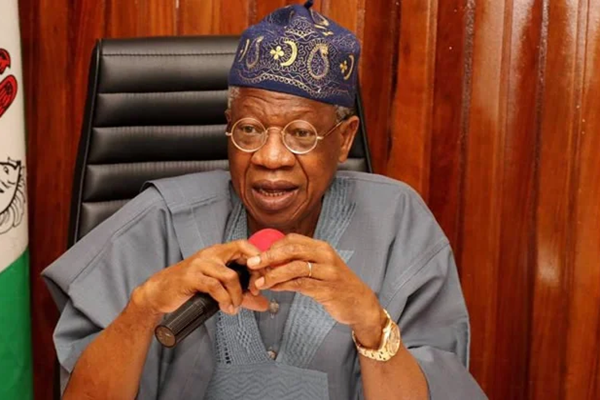
Former Minister of Information and Culture, Alhaji Lai Mohammed, has revealed how a carefully crafted, two-pronged communication strategy played a decisive role in the All Progressives Congress (APC) and President Bola Ahmed Tinubu’s victory in the 2023 general elections.
Mohammed made the disclosure in his newly launched book, “Headlines and Soundbites: Media Moments that Defined an Administration,” which documents key media interventions and governance milestones during the administration of the late President Muhammadu Buhari.
Recalling the tense political atmosphere ahead of the polls, Mohammed noted that despite President Buhari’s directive cautioning ministers against abandoning their official duties for political campaigns, he adopted a non-traditional approach to electioneering—one anchored on facts, performance documentation, and countering misinformation.
According to the former minister, opposition parties aggressively pushed a narrative portraying the APC-led Buhari administration as a failure with no tangible achievements to present to voters.
“That narrative was neither factual nor innocent. It was a deliberate attempt to rewrite history and discredit the administration and our party ahead of the elections,” Mohammed wrote.
To counter the claims, he said he deployed a two-pronged strategy: systematically showcasing the administration’s verifiable achievements and decisively challenging what he described as misleading opposition propaganda.
Mohammed revealed that exactly 130 days to the general elections—on October 18, 2023—his ministry launched the PMB Administration Scorecard Series (2015–2023), a nationwide initiative that provided detailed, evidence-based presentations of the Buhari administration’s accomplishments across all sectors.
Under the initiative, ministers delivered sector-by-sector reports supported by data and documentation, followed by interactive question-and-answer sessions where journalists rigorously interrogated the claims.
To amplify public reach, Mohammed said the ministry deployed an extensive multi-platform communication strategy spanning traditional media and digital channels.
He further disclosed that three days before the elections, on February 22, 2023, the ministry unveiled a final set of legacy documentation tools, including documentaries, testimonial series, a comprehensive compendium of Buhari’s achievements in print and digital formats, and an online legacy portal.
The legacy portal, he explained, served as a global digital repository housing all scorecard presentations and supporting materials.
Describing the initiative as one of the most innovative campaign strategies in Nigeria’s recent political history, Mohammed said it provided Nigerians with direct access to government achievements, reshaped political discourse, and forced opposition parties into a reactive posture.
“By placing verifiable facts in the hands of citizens, the opposition was compelled to play catch-up, often resorting to ad hominem attacks rather than substantive debate,” he stated.
Mohammed stressed that the strength of the strategy lay in its subtlety, discipline, and strict reliance on documented performance rather than overt political grandstanding.
He concluded that anchoring the campaign on facts and institutional accountability reaffirmed the power of strategic communication in shaping electoral outcomes—without breaching the ethical boundaries of public office.
Lai Mohammed Reveals Behind-the-Scenes Strategy That Powered APC, Tinubu’s 2023 Victory