


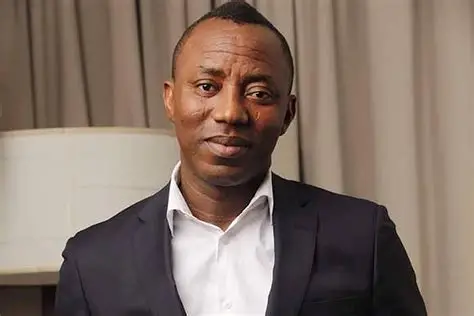
Presidential candidate of the African Action Congress (AAC), Omoyele Sowore, has criticised the Federal Government’s economic reforms, saying increased revenue and improved macroeconomic indicators have failed to translate into better living conditions for Nigerians.
Sowore made the remarks during an interview on Arise Television on Monday, where he argued that the success of the government’s economic policies should be measured by their impact on the standard of living of Nigerians.
According to him, economic progress should be reflected in improved wages, job creation, business growth, education, healthcare, security and infrastructure, rather than increased revenue, tax collection and the tax-to-GDP ratio.
Sowore accused the government of presenting economic figures to Nigerians without addressing the realities confronting households and businesses.
He questioned the relevance of a higher tax-to-GDP ratio when millions of Nigerians are struggling to afford basic necessities.
“We are talking about GDP to tax, but what about GDP to standard of living? Nobody is talking about that,” he said.
The AAC candidate said the Federal Government should provide evidence of the benefits of its economic reforms by pointing to new industries, jobs, schools, roads and other infrastructure created since the policies were introduced.
He also claimed that rising government revenue had coincided with worsening purchasing power, increasing living costs and difficulties for businesses across the country.
“Businesses are pretty much gone. You have closed down industries. Your people are poor. We are not just talking about poor people. We are talking about people who are multidimensionally poor,” Sowore said.
He particularly criticised the removal of fuel subsidy, arguing that the policy had increased the financial burden on ordinary Nigerians.
Sowore maintained that subsidies were not inherently bad, noting that governments around the world use various forms of subsidies to protect vulnerable citizens and support strategic sectors.
“There is no country in the world that doesn’t subsidise their poor. In fact, the people that get the most subsidy in Nigeria are not the poor. It’s the rich,” he said.
The activist alleged that wealthy individuals and businesses had benefited from government waivers and other incentives, while ordinary Nigerians bore the immediate effects of the removal of fuel subsidy.
He further linked the subsidy removal and other economic policies to the depreciation of the naira and worsening economic hardship.
“The moment you remove the subsidy, look at where your economy tanked. Your naira also went down the toilet,” he said.
Sowore called for a fundamental shift in Nigeria’s approach to economic management, urging the government to prioritise policies capable of creating jobs, strengthening businesses and improving access to essential services.
He also advocated measures that would make the minimum wage more meaningful while improving education, healthcare, security and infrastructure.
According to him, economic reforms should ultimately be judged by their impact on the lives and pockets of ordinary Nigerians.
“Optics don’t feed people. Propaganda can’t feed people. People are dying in this country of hunger and starvation. People can’t afford to live,” he said.
The AAC presidential candidate maintained that the Federal Government could not convincingly claim economic success while millions of Nigerians continued to struggle with basic living costs.
He urged greater accountability in the implementation of the reforms, insisting that the government must demonstrate how increased revenue is being converted into tangible improvements in the lives of Nigerians.