


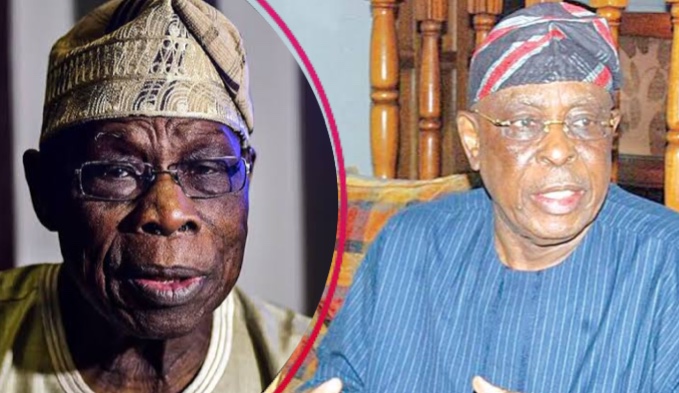
Former President Olusegun Obasanjo has rejected allegations by former Ogun State Governor, Aremo Olusegun Osoba, that he deceived leaders of the Alliance for Democracy (AD) during the political realignments that preceded the 2003 general elections.
In a letter dated July 23, 2026, titled “Reply to Your Inaccurate Posture: ‘How Obasanjo Deceived Us in 2003,'”Obasanjo described Osoba’s account, published in The Legal Observer on July 20, as inaccurate and misleading.
Obasanjo said he never deceived anyone during the political consultations that led to the elections, maintaining that he had always been transparent in his dealings.
“I take strong and serious objection to your calling me a deceiver because I deceived nobody. I always presented my case and all issues as I had them and as I understood them,” he said.
The former president stated that many of the political events leading to his emergence as president in 1999 were handled by senior Afenifere and AD leaders and were therefore not fully known to Osoba.
He disclosed that following his release from prison, several groups from different parts of the country urged him to contest for the presidency. According to him, consultations with political leaders across the South-West, North and South-East influenced his decision to join the Peoples Democratic Party (PDP).
Obasanjo also recalled his relationship with the late Afenifere leader, Chief Abraham Adesanya, saying they maintained mutual respect despite Adesanya’s refusal to support his presidential ambition.
He defended his decision to invite the Alliance for Democracy into a broad-based national government after winning the presidency, saying the move was intended to promote national unity rather than political weakness.
The former president also dismissed Osoba’s account of the attempted impeachment of former Speaker of the House of Representatives, Ghali Na’Abba, alleging that the impeachment plot originated from within his administration and was encouraged by his then vice-president, who was pursuing his own presidential ambition.
On the 2003 general elections, Obasanjo rejected Osoba’s claim that the defeat of AD governors resulted from manipulation by the Presidency. He insisted that the election results reflected the political realities at the time, adding that the defeats recorded in five of the six South-West states were genuine, while alleging that results were altered in one state.
Obasanjo maintained that his political decisions were guided by national interest and not by any intention to deceive political leaders or the electorate.