


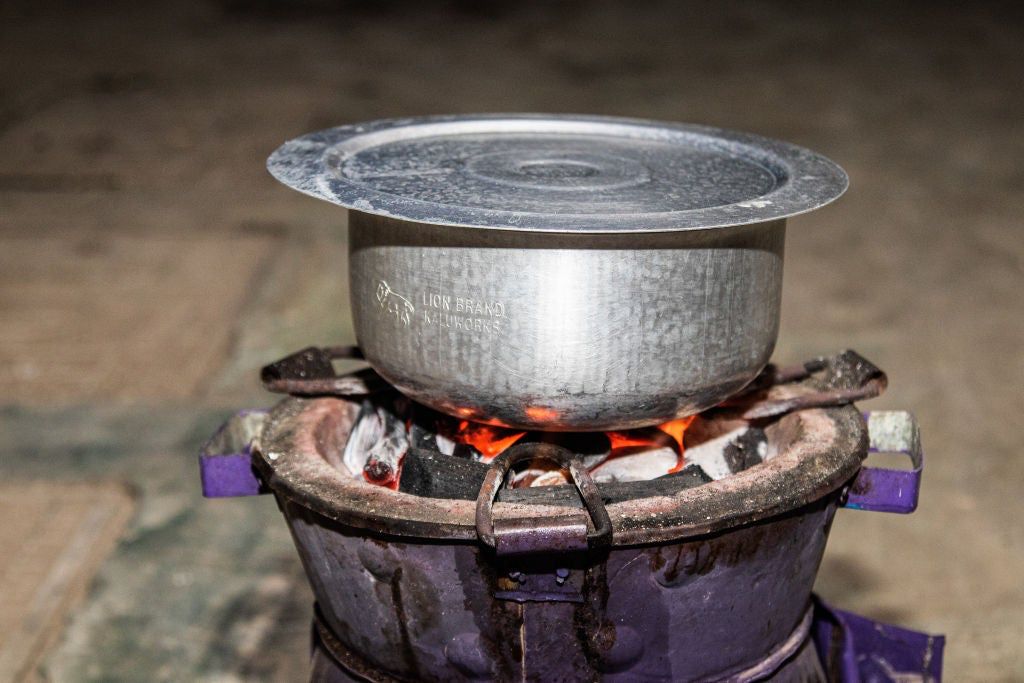
The sharp increase in cooking gas prices across the Federal Capital Territory (FCT) has compelled many households and business owners to abandon liquefied petroleum gas (LPG) in favour of cheaper alternatives such as charcoal and firewood.
Findings by the News Agency of Nigeria (NAN) revealed that the price of cooking gas has surged from about N1,200 per kilogram earlier in the year to as high as N2,000 per kilogram, placing additional financial pressure on residents already grappling with rising living costs.
Industry stakeholders attribute the increase to product scarcity, escalating depot prices, foreign exchange challenges, and higher transportation costs.
Many consumers who spoke with NAN on Sunday said the persistent rise in LPG prices has made cooking gas increasingly unaffordable, forcing them to seek less expensive alternatives.
A food vendor in Gwarimpa, Mrs. Mayo Akinpelu, said she discontinued the use of cooking gas after repeated price hikes made it difficult to sustain her business.
According to her, firewood and charcoal have become more practical options because they are cheaper and can be purchased in smaller quantities.
“Refilling my gas cylinder became difficult because the price kept increasing. I could no longer afford it and still make a reasonable profit. A 12.5kg cylinder now costs about N25,000 to refill,” she said.
Although customers occasionally complain about slower cooking times, Akinpelu noted that the switch has helped her keep her business afloat.
Similarly, a food vendor in Dutse, Bwari Area Council, Ms. Victory Samson, said the rising cost of gas has significantly reduced her profit margin.
“The increase has affected my business greatly. My profit margin has dropped, and I hope the government intervenes to bring prices down,” she said.
In Kubwa, business owner Mrs. Grace Oluwatimilehin described her shock after discovering that the price of gas had increased from N1,600 per kilogram during her previous purchase to N2,000 per kilogram within a short period.
To cope, she said she now relies on electric hot plates and occasionally uses charcoal and firewood.
Household consumers are also feeling the impact. Mrs. Abike Ojo, a mother of one, lamented that cooking gas has become increasingly difficult to afford.
“The last time I bought gas, it was N1,500 per kilogram, but my most recent purchase cost N2,000. If the trend continues, I may stop using gas altogether,” she said.
She called on the government to intervene, warning that further increases could worsen household financial burdens.
Gas vendors confirmed the sharp rise in prices and its impact on customer patronage.
A Kubwa-based gas retailer, Mr. Bamishile Bolanle, said LPG currently sells for N2,000 per kilogram, noting that many consumers now purchase smaller quantities due to reduced purchasing power.
“The increase has affected business significantly. Most customers buy less gas than before, and product scarcity appears to be a major factor behind the situation,” he said.
Another dealer in Dei-Dei, Mr. Alfred Orshio, said LPG prices had risen steadily from N1,200 per kilogram earlier in the year to the current N2,000.
“I understand why customers are cutting back. Refilling a 12kg cylinder now costs around N25,000, which is beyond the reach of many families,” he said.
Meanwhile, charcoal and firewood vendors reported a surge in demand as consumers increasingly move away from cooking gas.
A charcoal distributor in Kubwa, Mrs. Amina Yakubu, said sales have risen sharply in recent months.
“More people are buying charcoal because cooking gas has become too expensive. I purchase a bag for N6,500 and sell it for N8,000,” she explained.
Another charcoal trader, Mrs. Saratu Ibrahim, said demand has grown so rapidly that stock that once took over a week to sell is now exhausted within two days.
“Business has improved considerably, although more traders have entered the market due to the growing demand,” she said.
Firewood seller Mr. Taninu Ibrahim also reported increased patronage, particularly from households and food vendors seeking affordable cooking options.
According to him, the surge in demand has contributed to higher firewood prices.
“Previously, N1,000 could buy six pieces of firewood, but today it only buys four. Demand and transportation costs have pushed prices up,” he said.
Despite the increases, he noted that sales remain strong.
With cooking gas prices continuing to climb, more residents and businesses in the FCT are turning to traditional fuels, raising concerns about affordability, environmental sustainability, and the broader cost-of-living crisis.
Stakeholders have called on the government to stabilise LPG prices, warning that prolonged scarcity and weakening consumer purchasing power could further reduce gas consumption and negatively impact businesses.