


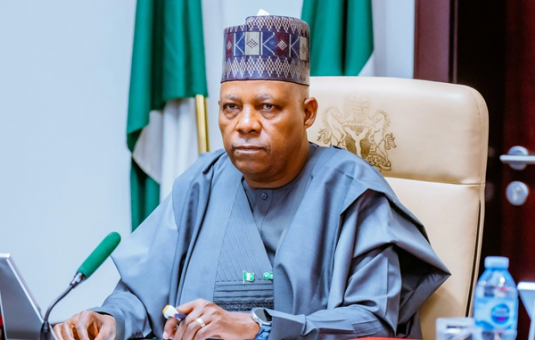
The Federal Government has reiterated its commitment to strengthening collaboration with the United Nations to accelerate empowerment programmes for women and youths across Nigeria, with a strategic focus on financial inclusion, skills acquisition, job creation, and national security.
Vice President Kashim Shettima made this known on Thursday at the Presidential Villa, Abuja, while receiving a delegation from the United Nations led by the Assistant Secretary-General on Youth Affairs, Felipe Paullier.
Shettima said the administration of President Bola Ahmed Tinubu recognises young people as a critical force for national transformation, describing them as the “engine of change” and the backbone of Nigeria’s development trajectory.
According to him, the government is committed to converting Nigeria’s large youth population into a demographic advantage through deliberate investments in human capital development, entrepreneurship, and employability.
He stressed that strategic partnerships with the UN and other development partners would be central to implementing programmes aimed at empowering women and youths to actively participate in nation-building.
In a statement by the Senior Special Assistant to the President on Media and Communications, Office of the Vice President, Stanley Nkwocha, Shettima reaffirmed that youth development remains a key priority under the Tinubu administration’s Renewed Hope Agenda.
“The youths are the backbone of every society’s transformation. On behalf of the President, I reaffirm this administration’s commitment to youth development,” Shettima stated.
He added that the administration is determined to ensure that Nigeria’s population growth translates into “demographic dividends” rather than socio-economic pressure, through sustained investment in education, skills training, and economic empowerment.
Shettima also emphasised the administration’s commitment to gender inclusion, noting that women and youths remain central to government policies and development programmes.
He further proposed stronger institutional frameworks to deepen cooperation between Nigeria and the United Nations in advancing long-term empowerment initiatives for women and young people.
Earlier, UN Assistant Secretary-General Felipe Paullier expressed appreciation for the engagement, describing Nigeria as a dynamic nation where young people play a pivotal role in shaping national and global development outcomes.
Paullier noted that his visit—the first to Nigeria—underscored the country’s importance in global youth development conversations, particularly in Africa.
He recalled that the United Nations established a dedicated youth office in 2022 to coordinate global efforts in education, skills development, and human rights protection for young people.
The UN official said the delegation’s visit aimed to strengthen ongoing collaboration with Nigeria and support multi-level interventions by UN agencies operating in the country.
He further commended Nigeria’s youth-focused initiatives, stressing that inclusive policies anchored on education, employment, and gender equality remain essential for sustainable development.