


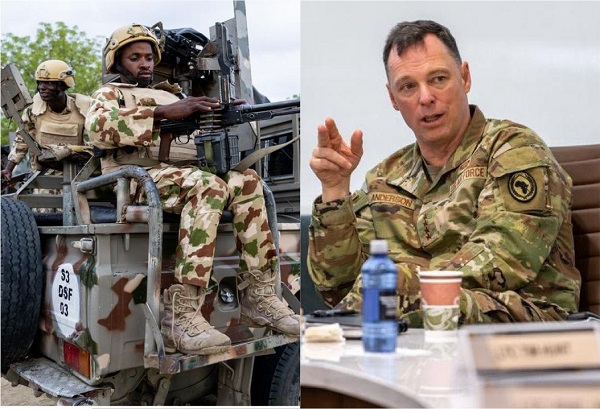
The United States is preparing to withdraw about 200 troops deployed to Nigeria after recording what American and Nigerian officials described as significant gains in the fight against terrorism in the country’s northern region.
The larger contingent is expected to leave Nigeria next month, although a smaller team of US trainers and intelligence analysts will remain to sustain security cooperation with Nigerian forces, according to The New York Times.
American officials have described the Nigeria deployment as a potential model for future US military operations in Africa, particularly those focused on training, intelligence-sharing and strengthening local security forces.
The Commander of the US Africa Command (AFRICOM), General Dagvin Anderson, acknowledged Nigeria’s progress in its counterterrorism campaign, highlighting a joint operation in May that resulted in the death of Abu-Bilal al-Minuki, identified as the second-in-command of ISIS in the Lake Chad Basin.
Anderson said Nigeria had remained “very active” following the operation, particularly in efforts to prevent terrorist groups from developing the capacity to operate independently.
He added that the United States would maintain its intelligence partnership with Nigeria despite the withdrawal of the larger troop contingent.
The American military personnel and equipment arrived in Nigeria in February following a request by the Federal Government for assistance with military training, technical support and intelligence-sharing in the fight against Islamic militants and other armed groups.
The development comes as senior Nigerian and US officials continue discussions on strengthening bilateral security cooperation.
The two countries held the second meeting of their Joint Working Group in Washington, D.C., from August 12 to 13, 2026.
Nigeria’s delegation was led by National Security Adviser, Mallam Nuhu Ribadu, while the US side was headed by Under Secretary of State for Political Affairs, Allison Hooker.
The Joint Working Group was established amid heightened discussions over Nigeria’s security situation following US President Donald Trump’s designation of Nigeria as a “Country of Particular Concern” over allegations of religious persecution.
Tinubu: Security remains key to economic prosperity
Meanwhile, President Bola Tinubu has declared that protecting the lives and property of Nigerians remains non-negotiable, stressing that sustainable economic development cannot be achieved without peace and security.
Tinubu made the declaration at the graduation ceremony of Course 34 of the National Defence College (NDC) in Abuja, where he was represented by Vice President Kashim Shettima.
The President reaffirmed his administration’s commitment to strengthening the Armed Forces and other security agencies in the fight against terrorism, banditry, kidnapping, piracy and organised crime.
He pledged continued government support through the provision of equipment, training, resources and institutional backing to enable security agencies to effectively perform their constitutional duties.
“Our economic ambitions accompany the duty to secure our people. The Armed Forces and security agencies continue to confront terrorism, banditry, kidnapping, piracy and organised criminality with courage and professionalism,” Tinubu said.
He added that restoring security in troubled communities must go hand in hand with economic opportunities that would encourage stability.
“When communities recover security, opportunity must follow, because stability grows where people can work, trade, learn and hope,” he said.
Tinubu said his administration’s security strategy was closely linked to its economic reforms under the Renewed Hope Agenda, which seeks to strengthen macroeconomic stability, stimulate local industries, attract investment and expand infrastructure.
He listed agriculture, solid minerals, manufacturing, technology and defence industries among sectors the government is seeking to strengthen.
According to the President, investments in roads, railways, ports, energy and digital infrastructure would help reduce business costs, connect markets and promote national integration.
He also stressed that Africa’s long-term security would increasingly depend on the continent’s ability to build productive economies, create jobs for its youthful population and develop strong industrial capacity.
“Africa’s security will increasingly depend on productive economies, regional value chains, innovation, and industries capable of employing its young population,” Tinubu said.
With the African Continental Free Trade Area (AfCFTA) driving continental economic integration, the President urged African countries to prioritise industrialisation as a means of achieving inclusive growth and strengthening economic resilience.
He reaffirmed Nigeria’s commitment to building “a peaceful, prosperous, integrated Africa.”
103 graduate from National Defence College
The President also commended the National Defence College for its contribution to strategic leadership development and national security.
The Commandant of the college, Rear Admiral Abdullahi Ahmed, said Course 34 participants underwent 47 weeks of intensive training, including research, field tours and seminar presentations.
He said the programme focused on contemporary security and developmental challenges as well as high-level defence management.
A total of 103 participants graduated from the course.
The graduates comprised 33 Nigerian Army officers, 20 Nigerian Navy officers, nine Nigerian Air Force officers, four Nigeria Police Force officers, 17 participants from Ministries, Departments and Agencies, and 20 international participants.
The high point of the ceremony was the presentation of certificates to the graduates and awards to outstanding participants.
Troops inflict losses on Lakurawa terrorists in Sokoto
Meanwhile, Nigerian troops have intensified operations against terrorist groups in the North-West.
Operatives of the Nigerian Army’s 8 Division and Joint Task Force North West, Operation FANSAN YAMMA, reportedly inflicted heavy losses on Lakurawa terrorists in Rabah Local Government Area of Sokoto State.
The troops, acting on credible intelligence, intercepted the terrorists while they were on the move, reportedly neutralising two of them and recovering weapons and motorcycles.
Two days earlier, joint military teams had also repelled coordinated attacks targeting the Sifawa military barracks and nearby communities, including Badau and Danchadi, in Sokoto State.
21 Boko Haram terrorists killed in Adamawa operation
In Adamawa State, at least 21 suspected Boko Haram terrorists were reportedly killed during a joint security operation around the Kopre Mountain general area of Hong Local Government Area.
According to Zagazola Makama, which cited military sources, several other terrorists escaped during the encounter.
The security forces also destroyed the terrorists’ camp and recovered or destroyed motorcycles, bicycles and jerry cans containing Premium Motor Spirit believed to belong to the group.
However, a local hunter who participated in the joint operation was killed during the confrontation.
The latest operations come amid intensified efforts by Nigerian security forces and their international partners to degrade terrorist groups and prevent them from establishing operational strongholds across the country.