


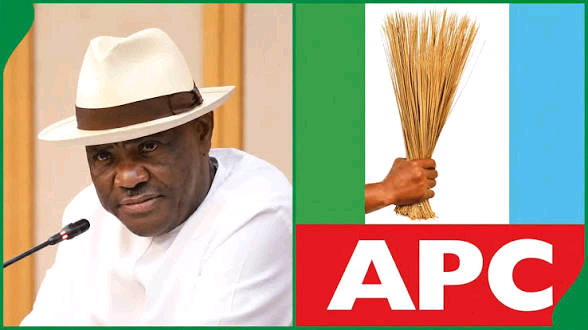
A deepening fault line has opened within the ranks of those backing President Bola Ahmed Tinubu’s 2027 re-election bid, pitting Federal Capital Territory Minister Nyesom Wike’s cross-party “Rainbow Coalition” against the All Progressives Congress (APC) governors and grassroots leaders determined to protect the party’s own structures.
The APC Grassroots Organisation has publicly urged the President and party leaders to rein in Wike’s mobilisation efforts, warning that the emerging multi-party platform risks creating a parallel political machine that could undermine APC candidates at state and legislative levels. In a statement signed by its chairman, Mukhtar Tanimu Rabiu, the group stressed that support for Tinubu must not come at the expense of the party’s established machinery.
“Supporting the President’s ambition should not be separated from protecting the APC structures through which the party’s candidates will contest,” Rabiu said. The organisation argued that a separate platform mobilising for Tinubu while potentially backing candidates from other parties could generate competing interests and weaken the ruling party’s electoral prospects.
Wike has pushed back firmly. The FCT Minister maintains that the Rainbow Coalition is an independent, multi-party vehicle designed solely to broaden support for Tinubu’s re-election and has nothing to do with the APC’s internal structures. He has insisted he never sought an alliance with the Progressive Governors’ Forum and has dismissed the governors’ concerns as those of “politically lazy” leaders focused on protecting their own interests rather than expanding the President’s base.
The Progressive Governors’ Forum, led by Imo State Governor Hope Uzodimma, has drawn a clear line. The governors declared they will not participate in or endorse any arrangement that could weaken the APC or harm its officially nominated candidates. They affirmed full support for Tinubu while insisting that party structures and candidates at every level must remain central to the 2027 campaign.
The dispute has also revived debate over the role of the former G-5 governors in Tinubu’s 2023 victory. The APC Grassroots Organisation challenged claims that Wike and his erstwhile colleagues were indispensable, arguing that electoral records do not support such assertions. The G-5, which included Wike, Seyi Makinde, Samuel Ortom, Okezie Ikpeazu and Ifeanyi Ugwuanyi, had broken with the Peoples Democratic Party after its 2022 presidential primary and withheld support from Atiku Abubakar. Wike has cited that experience as proof that politicians can back a presidential candidate across party lines without formally joining the candidate’s party.
Reactions within the APC have largely aligned with the governors. South-East party leaders have endorsed the Progressive Governors’ Forum’s stance, calling for disciplined support of APC candidates and rejecting arrangements seen as threats to the party’s organisational integrity. The Grassroots Organisation has continued to warn that Wike’s activities risk sowing division inside the ruling party—an allegation the minister has rejected, reiterating that his sole focus is Tinubu’s re-election.
As the 2027 elections draw closer, the contrasting approaches—Wike’s broad, cross-party mobilisation versus the governors’ insistence on strengthening APC structures—have placed the relationship between Tinubu’s wider support base and the party’s formal machinery under sharper scrutiny. For now, both camps claim to be working for the President’s success, but the emerging tension suggests that managing that success without fracturing the ruling party will be a central political challenge in the months ahead.