

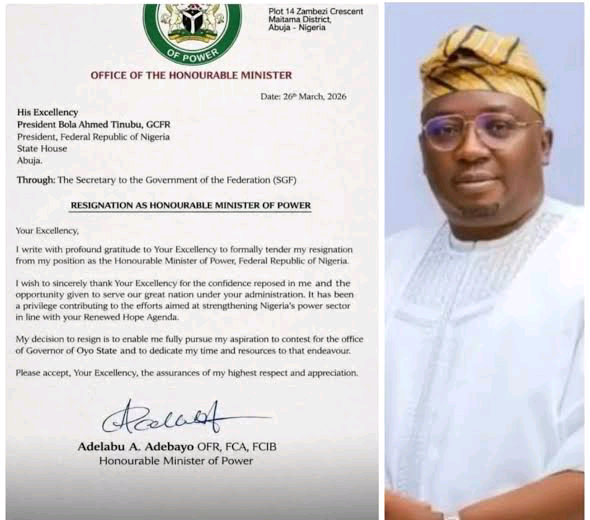
The resignation of Adebayo Adelabu as Nigeria’s Minister of Power is shaping up to be far more than a routine cabinet change—it is widely seen as the opening move in a high-stakes political contest ahead of the 2027 governorship race in Oyo State.
Multiple sources within the Presidency and ruling party confirm that Adelabu’s April 22 resignation, submitted to Bola Ahmed Tinubu, followed weeks of quiet negotiations, strategic consultations, and internal party alignments.
While official statements frame his departure as the pursuit of a “long-standing ambition,” insiders describe it as a calculated and well-timed political decision. According to a senior government official, pressure had been mounting on Adelabu to clarify his political intentions early to prevent internal divisions within the All Progressives Congress (APC), particularly in Oyo State.
“This was not sudden,” a source revealed. “The President was fully aware. Adelabu needed to step aside to avoid conflicts of interest and begin full-scale political consultations back home.”
Power Sector Faces Uncertainty
The immediate aftermath of the resignation has sent ripples through the Ministry of Power. Senior officials reportedly convened emergency meetings as ongoing reforms in Nigeria’s already fragile electricity sector slowed.
Key policy decisions have been temporarily put on hold, with expectations that an acting minister will soon be appointed to stabilize operations. The timing is critical, as the sector continues to grapple with persistent challenges including generation shortfalls, transmission constraints, and distribution inefficiencies.
Analysts warn that even a short leadership vacuum could deepen instability in the power supply chain.
Oyo Political Landscape Shifts Rapidly
Back in Oyo State, Adelabu’s return has dramatically altered the political terrain—particularly in Ibadan, where his loyalists have already begun closed-door mobilisation.
Within 24 hours of his resignation:
- Political groups aligned with Adelabu initiated strategic meetings
- APC factions resumed negotiations over zoning and party control
- Opposition figures began recalibrating their strategies
A party chieftain described the development bluntly: “His entry changes everything. He brings federal backing, financial strength, and unfinished political business.”
Renewed Rivalries and APC Tensions
Adelabu’s re-entry is expected to revive old rivalries from previous governorship contests, while also intensifying internal struggles within the APC over control of party structures in Oyo.
Potential flashpoints include:
- Clashes with entrenched political interests
- Fierce competition for the party ticket
- Expanded grassroots mobilisation targeting youth and civil servants
Despite his past electoral defeat, analysts believe Adelabu now holds strategic advantages, including stronger name recognition, a refined political network, and lessons learned from earlier campaigns.
Presidency’s Measured Silence
The Presidency has so far maintained a cautious stance. While aides to President Tinubu have acknowledged receipt of the resignation, there has been no overt endorsement of Adelabu’s political ambitions.
However, insiders suggest the move aligns with broader APC calculations ahead of 2027. Adelabu is still regarded as a trusted figure within the President’s political circle, and his ambition is seen as potentially critical to consolidating the party’s influence in the South-West.
What Comes Next
The coming weeks are expected to be decisive. Key developments to watch include:
- Appointment of a new or acting Minister of Power
- Formal declaration of Adelabu’s governorship bid
- APC’s internal positioning and possible primaries battle
- Reactions from opposition parties across Oyo State
A Defining Moment
Adelabu’s resignation is more than a personal political decision—it is a trigger event with both national and regional implications.
For Nigeria’s power sector, it introduces short-term uncertainty.
For Oyo politics, it signals the beginning of a fierce and strategic contest.
For the APC, it presents an early test of unity as ambitions collide ahead of 2027.
As the situation unfolds, all eyes remain on how this calculated move reshapes both governance and political power in the months ahead.