
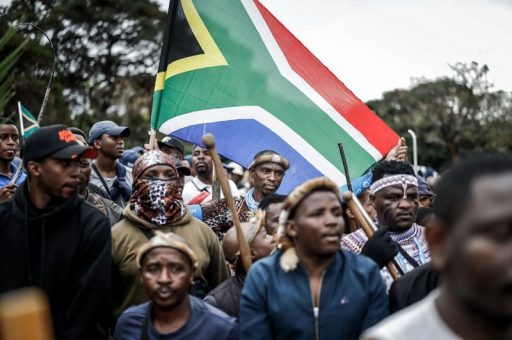
Thousands of anti-migrant protesters marched across South Africa on Tuesday, forcing businesses, shopping malls and markets to close amid fears of xenophobic attacks, as Nigeria evacuated another 271 citizens from the country.
The latest evacuation brought the total number of Nigerians airlifted home by the Federal Government to more than 600, with authorities confirming that additional flights had been scheduled for those seeking voluntary repatriation.
The returnees arrived at the Murtala Muhammed International Airport (MMIA), Lagos, aboard an Air Peace flight, where they were received by officials of the Ministry of Foreign Affairs and other government agencies.
The protests followed an ultimatum issued by anti-immigrant groups demanding the deportation of undocumented migrants, prompting South African security agencies to deploy heavily across major cities.
Police arrested several suspects over incidents of looting and vandalism linked to the demonstrations. Five people were arrested for allegedly looting a foreign-owned shop in Soweto, while another five were detained after reportedly breaking into a shop in Hammarsdale, KwaZulu-Natal. Protesters also smashed windows of apartments in Johannesburg’s Yeoville district, home to many African migrants.
Ahead of the demonstrations, South African President Cyril Ramaphosa appealed for calm, urging protesters to avoid violence and intimidation.
While acknowledging concerns over illegal migration, Ramaphosa noted that millions of foreign nationals reside legally in South Africa and contribute to the country’s economy.
He stressed that the right to protest does not include acts of violence, vandalism or intimidation.
Despite the appeal, businesses remained closed in several areas as residents stayed indoors.
President of the Nigeria Citizens Association in South Africa (NICASA), Rev. Frank Onyekwelu, said shopping malls, supermarkets and business premises shut their doors while security personnel, including police, soldiers and metro officers, were deployed to prevent violence.
He disclosed that tensions almost escalated on Monday after some foreign nationals confronted protesters over repeated intimidation before police restored order.
The protests followed weeks of anti-immigrant campaigns by groups accusing foreigners of taking jobs, engaging in criminal activities and placing pressure on public services.
One of the groups, March and March, had demanded the mass deportation of undocumented migrants by June 30.
The recent wave of xenophobic attacks has reportedly claimed at least three lives, including two Mozambicans and one Malawian, while hundreds of migrants have sought refuge in churches and mosques.
South African authorities disclosed that about 50,000 undocumented migrants had been detained since January, with approximately 25,000 already repatriated. Official records indicate that more than three million documented foreign nationals currently live in the country.
Nigeria’s Senior Special Assistant to the President on Foreign Affairs, Ademola Oshodi, warned that the Federal Government would not tolerate attacks on its citizens.
Speaking on Al Jazeera, Oshodi urged South African authorities to investigate reported attacks, protect foreign nationals, restrain vigilante groups and prosecute those responsible.
He also called for the activation of the Nigeria-South Africa Early Warning Mechanism, stressing that while South Africa has the right to enforce its immigration laws, such actions must be carried out through lawful institutions rather than mobs.
Oshodi recalled Nigeria’s support for South Africa during the anti-apartheid struggle, saying the long-standing relationship between both countries should not prevent Nigeria from speaking out whenever its citizens are threatened.
Many of the 271 returnees recounted losing businesses, homes and livelihoods during the unrest.
The Federal Government provided the returnees with food items, toiletries and other relief materials, while MTN Nigeria donated SIM cards loaded with airtime worth N50,000 alongside N100,000 cash support.
The Imo State Government pledged N1 million to each of its returning indigenes, while Harvesters Church also announced N1 million support packages. Edo State offered transportation and promised additional reintegration assistance.
Several returnees described years of hardship and humiliation.
Emmanuela Akagbosun said Nigerians were increasingly targeted, alleging that foreigners were being forced out of their homes.
Another returnee, Joan, said she lost her business after spending 15 years in South Africa and appealed for government assistance to rebuild her life.
Izuna Fidelis also accused immigration officials of harassing Nigerians and demanding bribes during documentation processes.
The returnees rejected allegations that Nigerians dominate the illicit drug trade in South Africa, insisting that the majority are law-abiding entrepreneurs.
The Ministry of Foreign Affairs said officials of the Nigerian High Commission accompanied the evacuees throughout the journey and reaffirmed that evacuation flights would continue until all Nigerians wishing to return had been airlifted.
The ministry added that diplomatic engagement with South African authorities would continue to protect Nigerians residing legally in the country while facilitating the voluntary return of those affected by the immigration crackdown.
Minister of Humanitarian Affairs and Poverty Reduction, Dr. Bernard Doro, commended the returnees and assured them of the Federal Government’s commitment to their reintegration.
He said the evacuees had not been deported for any criminal offence but voluntarily returned after enduring difficult conditions while trying to earn a living abroad.
Doro described reintegration as a process that extends beyond airport reception to include humanitarian assistance, livelihood support and long-term opportunities, urging state governments, development partners and the private sector to contribute to the effort.
The National Commission for Refugees, Migrants and Internally Displaced Persons (NCFRMI) said it would continue supporting returnees as they rebuild their lives.