
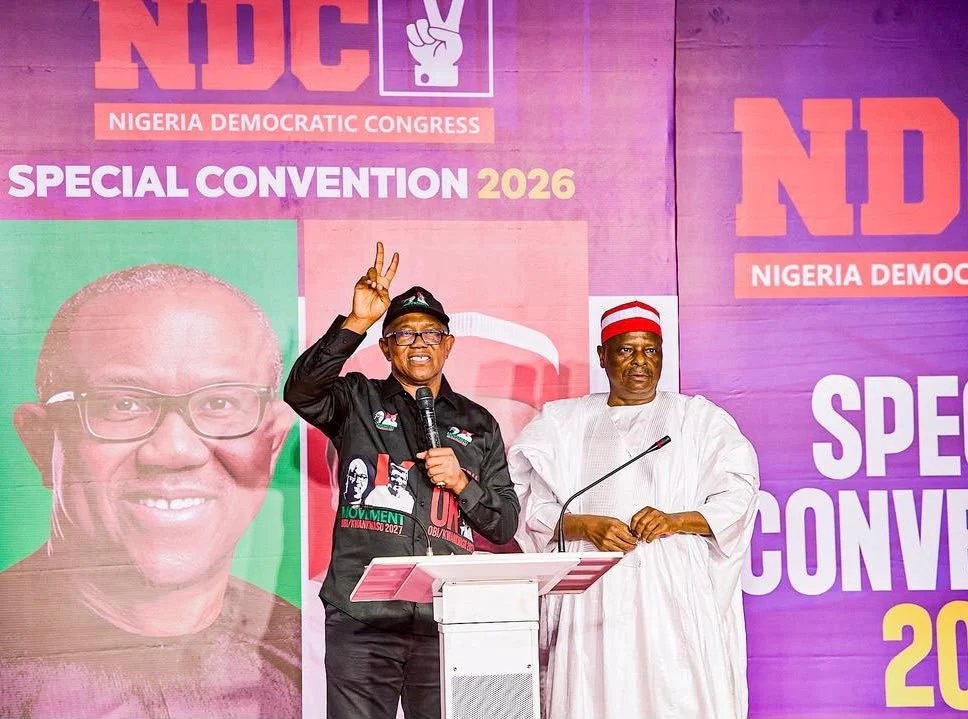
Peter Obi, the presidential candidate of the Nigerian Democratic Congress (NDC), has pledged to give Senator Rabiu Kwankwaso a meaningful role in government, declaring that his running mate would serve as a “partner, not a spare tyre” if they emerge victorious in the 2027 presidential election.
Obi made the declaration on Sunday while delivering his acceptance speech after being formally affirmed as the NDC’s presidential candidate. The speech was contained in a statement shared via his X account.
The former Anambra State governor had on Saturday officially unveiled Kwankwaso, a former governor of Kano State, as his vice-presidential candidate ahead of the 2027 polls.
Both politicians were contenders in the 2023 presidential election, where Obi finished third while Kwankwaso placed fourth. They trailed President Bola Tinubu, who won the election, and former Vice President Atiku Abubakar.
In his acceptance speech, Obi described his nomination as a call to national service and reaffirmed his commitment to building a “New Nigeria” founded on unity, security, economic prosperity, and accountable leadership.
He expressed gratitude to party stakeholders, including National Chairman Seriake Dickson, the National Secretary, members of the National Working Committee (NWC), and supporters across the country for their confidence in his leadership.
According to Obi, Nigeria is currently facing significant challenges, including worsening insecurity, economic hardship, and declining public confidence in government institutions.
Addressing national unity, he cautioned against divisions along ethnic, religious, and regional lines, stressing that Nigeria’s diversity should be harnessed as a source of strength rather than conflict.
On security, Obi noted that the country’s security situation had deteriorated over the years, citing global terrorism rankings that placed Nigeria among the nations most affected by terrorism.
He highlighted Nigeria’s longstanding reputation in international peacekeeping operations, commending the professionalism and sacrifices of the country’s armed forces across conflict zones in Africa and beyond.
“No nation can prosper when its citizens live in fear. The protection of lives and property remains the foremost responsibility of government,” Obi stated.
On healthcare, the presidential candidate expressed concern over the state of the nation’s health sector, noting that only a fraction of Nigeria’s primary healthcare centres are fully functional and that health insurance coverage remains low.
He pledged to expand health insurance coverage beyond 20 per cent within four years, increase healthcare funding to at least 10 per cent of Gross Domestic Product (GDP), and rehabilitate primary healthcare centres across the country’s 8,809 wards while improving workforce training and staffing.
Obi also identified education as a major pillar of his proposed administration, promising increased investment in schools, teachers, vocational training, and human capital development to boost productivity and innovation.
Speaking on agriculture and food security, he expressed concern over rising hunger levels and food insecurity across the country. He pledged to unlock Nigeria’s agricultural potential through strategic investments aimed at increasing food production and creating jobs.
In the energy sector, Obi described Nigeria’s current electricity generation capacity as inadequate for its growing population. He promised to increase power generation by at least 10,000 megawatts within four years to support industrial growth and economic development.
The former governor also addressed unemployment, arguing that actual unemployment and underemployment rates are significantly higher than official figures suggest, particularly among young people.
To tackle the challenge, he pledged support for micro, small and medium-sized enterprises (MSMEs) through tax incentives, improved access to funding, and targeted interventions across key sectors of the economy.
Obi further vowed to strengthen democratic institutions, uphold the rule of law, reduce corruption, and cut the cost of governance.
Reaffirming his confidence in his choice of running mate, Obi said his administration would foster genuine collaboration at the highest levels of government.
“I will make democracy work, and the Vice President will be a partner, not a spare tyre. I hereby accept my affirmation and nominate Senator Rabiu Kwankwaso as my Vice President,” he declared.