

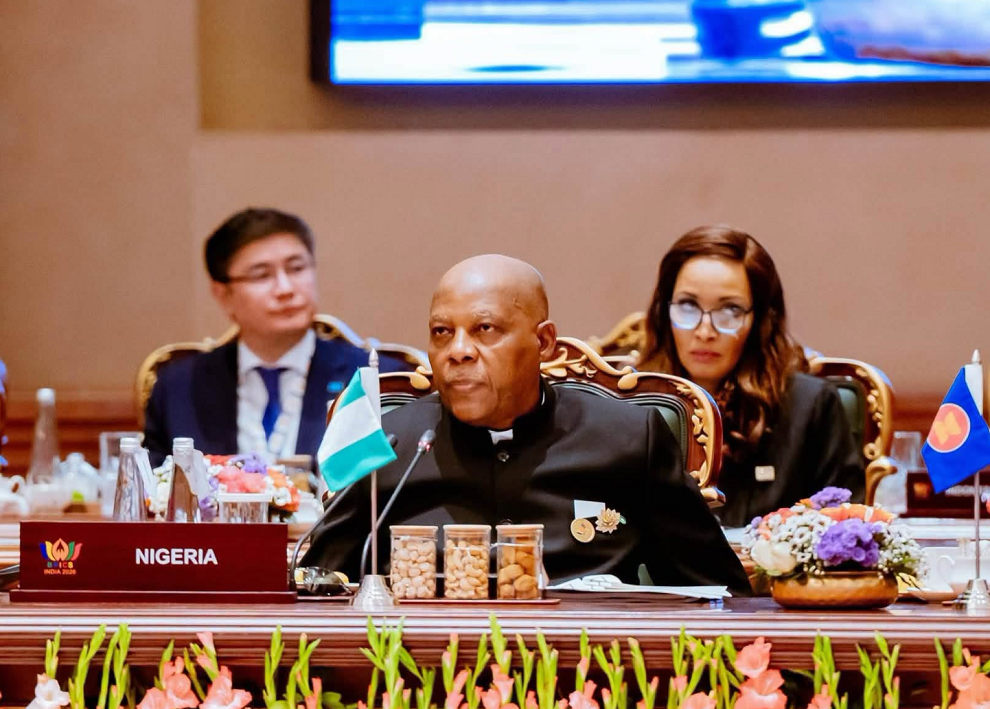
President Bola Ahmed Tinubu has warned that developing nations risk surrendering control of their destinies unless they shift from being mere consumers of technology to producers who create knowledge and own intellectual property.
“A nation that owns no technology risks renting its future,” Tinubu declared in an address delivered on his behalf by Vice President Kashim Shettima at the 18th BRICS Leaders’ Summit in New Delhi, India.
The Nigerian leader challenged BRICS members and partners to deepen collaboration in artificial intelligence, digital public infrastructure, fintech, telecommunications, cybersecurity, biotechnology and advanced manufacturing. He said Nigeria is determined to leverage its youthful population and expanding innovation ecosystem to become a technology producer rather than a perpetual consumer.
Tinubu highlighted ongoing domestic investments in digital skills, entrepreneurship, research and technology-enabled businesses through programmes such as the 3 Million Technical Talent (3MTT) initiative, Project BRIDGE and national artificial intelligence programmes. As Project BRIDGE expands broadband, fibre networks and digital public services, he said Nigeria seeks an open, secure and inclusive digital ecosystem that advances innovation, digital trade, responsible AI and cybersecurity.
Nigeria regards its engagement with BRICS as a practical platform for trade, investment, technology transfer and human-capital development, not merely another diplomatic talking shop. The President expressed support for partnerships in infrastructure, connectivity, energy, agriculture, healthcare, education and industrialisation, underpinned by development finance.
Beyond technology, Tinubu called for urgent reform of global governance structures and international financial institutions so they better reflect contemporary economic and demographic realities. He reiterated Nigeria’s backing for a more representative United Nations Security Council and a fairer international financial system, noting that BRICS amplifies the voice of the Global South.
He urged a BRICS partnership that moves “from dialogue to delivery, from commitments to implementation, and from cooperation to measurable development outcomes.” Tinubu also invited foreign investors to view Nigeria as a gateway to Africa’s expanding market under the African Continental Free Trade Area (AfCFTA).
Economic resilience, he said, means building an economy capable of withstanding global shocks while creating sustainable opportunities for citizens — goals embedded in the administration’s Renewed Hope Agenda through macroeconomic reforms, production diversification, infrastructure expansion, private-sector growth and climate resilience.
On climate change, Tinubu stressed that sustainability efforts must balance environmental responsibility with the development aspirations of emerging economies. Nigeria supports affordable climate finance, technology transfer and capacity-building, alongside greater cooperation in renewable energy, gas, clean technologies, climate-smart agriculture and responsible critical-mineral development.
“Our partnerships must create jobs, expand trade, transfer technology, and strengthen our nations’ productive capacity. We must build a future in which Africa moves from the margins of global development to the frontiers of global growth and innovation,” he said.
Indian Prime Minister Narendra Modi, hosting the summit, noted growing confidence in BRICS among Global South countries because their voices are heard and solutions are developed with them rather than for them. He highlighted the bloc’s diversity and expanding engagement with entrepreneurs, farmers, researchers, women and youth through initiatives such as BRICS CONNECT, the BRICS MSME Cooperation Portal and the BRICS Urban Mobility Hub, while stressing the need to keep sustainability central to