
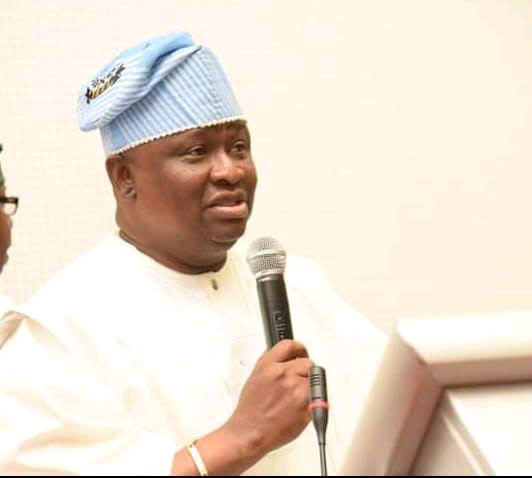
In Ogun State’s intensifying political contest, Senator Solomon Olamilekan Adeola, popularly known as Yayi, has emerged as a central and polarizing figure. Critics, civil society observers, and some aggrieved All Progressives Congress (APC) members say his rapid shift from long-standing influence in Lagos to Ogun West, and his push toward the state governorship, has sidelined constitutional norms, grassroots representation, and internal party democracy in favor of financial muscle and institutional leverage.
Cross-Border Move Draws Fire
Adeola built a lengthy political career in Lagos, serving in the State House of Assembly, the House of Representatives, and two terms as senator for Lagos West. His decision to seek the Ogun West senatorial seat and later position himself for higher office in Ogun has been described by opponents as political carpetbagging.
Supporters point to constitutional guarantees of free movement and association. Critics counter that the move undermined the spirit of federal character and local representation, portraying it as an external takeover designed to overwhelm indigenous aspirations with institutional clout and resources.
Public Funds and Political Branding
As a senior National Assembly figure who has chaired the powerful Senate Committee on Appropriations, Adeola has overseen significant federal constituency projects and interventions in Ogun. Petitions and public complaints have questioned the practice of presenting taxpayer-funded infrastructure and empowerment programs under personal campaign branding, arguing that this blurs the line between statutory duty and partisan patronage.
Observers say the pattern risks turning public development into a tool for building loyalty and projecting political dominance.
Engineered Consensus and Internal Party Tensions
Within the APC in Ogun, Adeola’s emergence as a consensus candidate has been widely criticized as a closed-door arrangement rather than the product of open dialogue among aspirants. Potential contenders with strong local bases were reportedly sidelined, pressured, or edged out through a combination of federal connections and financial weight.
The approach has also affected sitting and aspiring lawmakers. Several long-serving and rising figures have allegedly been denied return tickets or faced political marginalization, fueling claims that party tickets are being treated as instruments of personal loyalty rather than rewards for performance or grassroots support. Party insiders describe a surface unity masking deep resentment among those whose ambitions were cut short.
Opposition Challenges and Alleged Proxy Tactics
The contest has extended beyond the ruling party. Opposition figures have pointed to delays and complications surrounding the candidacy of Peoples Democratic Party (PDP) aspirant Hon. Oladipupo Adebutu at the Independent National Electoral Commission (INEC). While APC allies attribute the issues to internal PDP problems and procedural lapses, opposition voices allege external interference aimed at keeping challengers tied up in legal and administrative battles.
A particularly striking episode involved Topa Peter, a grassroots party official from Imeko-Afon. In public statements, Peter said he never purchased a gubernatorial nomination form, never contested primaries, and had no interest in the office. He claimed his name was being used without consent to file petitions and generate litigation that could complicate Adebutu’s path and provide grounds for institutional delays. Whether directed from the top or carried out by proxies, such tactics have been labeled by critics as an abuse of regulatory processes intended to limit genuine electoral choice.
The Stakes for Ogun
Ogun State, long regarded as a cradle of intellectual, judicial, and cultural leadership—home to figures such as Chief Obafemi Awolowo, Sir Adetokunbo Ademola, Chief Funmilayo Ransome-Kuti, and Professor Wole Soyinka—carries a tradition of principled politics and civic awareness.
Critics argue that attempts to secure power through manufactured consensus, institutional pressure, and financial dominance misjudge the state’s political culture. They insist that leadership in the Gateway State must rest on open competition of ideas, character, and verifiable records rather than asymmetric tactics.
As the political temperature rises, the debate centers on whether Ogun’s future will be shaped by transparent democratic contestation or by the consolidation of influence through other means.