
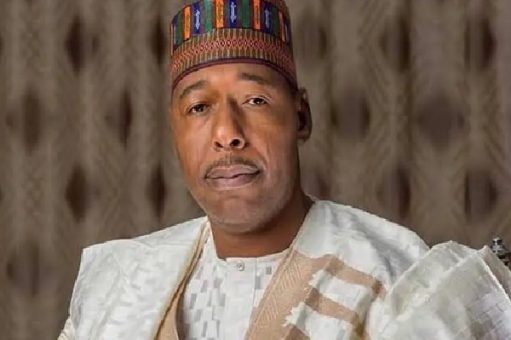
Borno State Governor Babagana Umara Zulum has strongly opposed an alleged attempt by certain individuals to dispose of vital agricultural and industrial equipment belonging to the Chad Basin Development Authority (CBDA) under the guise of scrap metal auctioning.
The governor described the reported move as economic sabotage capable of undermining ongoing efforts to revive agriculture, restore livelihoods, and resettle communities affected by years of insurgency across Borno State and the wider Northeast region.
Speaking in a statement issued in Maiduguri on Sunday, Zulum called on the Federal Government, the Presidency, and the Federal Ministry of Water Resources to urgently intervene and halt any planned auction of the assets.
According to the governor, most of the equipment targeted for disposal remains functional and plays a critical role in the operations of the CBDA.
“It has come to the attention of the Borno State Government that some unscrupulous elements are attempting to cart away heavy equipment domiciled at the CBDA premises and booster stations across Northern Borno in the name of scrap metal auctioning,” Zulum stated.
He maintained that the Federal Government acquired the equipment at significant cost and argued that there was no justification for disposing of assets that are still serviceable.
“The equipment is still functional. Auctioning it would cripple the Chad Basin Development Authority and weaken the agricultural value chain in our state,” he said.
The governor’s concerns come shortly after the Federal Government reconstituted the management of the CBDA as part of efforts to strengthen food production, irrigation farming, rural development, and economic recovery within the Lake Chad Basin region.
Among the assets reportedly marked for disposal are irrigation facilities, booster stations, drilling machines, electricity generation equipment, tractors, bulldozers, combined harvesters, pipelines, and crop-processing machinery.
Zulum warned that removing such equipment from operational sites would significantly impair the authority’s ability to fulfil its mandate and could derail efforts aimed at improving food security across the region.
He further accused those behind the alleged plan of working against national initiatives to rebuild communities devastated by more than a decade of Boko Haram insurgency.
“While the Federal Government is working tirelessly to defeat Boko Haram, facilitate the resettlement of displaced persons, and revive agriculture and rural livelihoods, some heartless individuals are plotting to frustrate these efforts for personal gain,” he said.
“The people of Borno will not stand by and watch public assets and our collective patrimony being looted under any guise.”
The governor also linked the growing trend of metal scavenging to criminal activities in insurgency-affected communities, warning that proceeds from the illegal sale of public infrastructure could find their way into criminal and terrorist networks operating around the Lake Chad Basin, Sambisa Forest, and the Timbuktu Triangle.
“It would be a tragic irony if public assets meant to support agriculture and economic recovery are vandalised and sold in ways that ultimately benefit criminal and terrorist elements,” he cautioned.
Reaffirming his administration’s ban on scrap metal activities, Zulum stressed that the policy remains in force and vowed that no individual or group would be permitted to remove metals or public equipment from the state.
“We are recovering from years of insurgency. These assets are crucial to rebuilding our economy and strengthening our agricultural and industrial base. We shall not allow anyone to destroy what belongs to the people,” he declared.
The governor also urged the military, security agencies, and relevant law enforcement bodies to strengthen surveillance around CBDA facilities and other strategic infrastructure to prevent vandalism and safeguard public assets.
His warning highlights growing concerns that the controversial disposal of critical infrastructure could undermine ongoing efforts to transform the Lake Chad Basin into a major centre for agricultural productivity and economic recovery in northeastern Nigeria.