
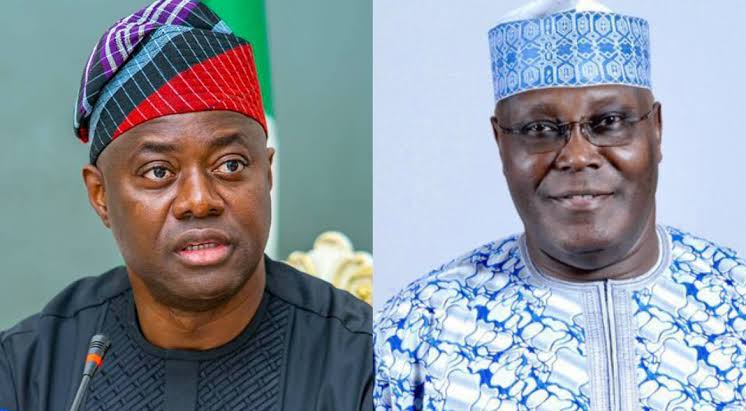
The renewed drive to unite Nigeria’s opposition ahead of the 2027 general election may be opening the way for a possible presidential ticket featuring former Vice-President Atiku Abubakar and Oyo State Governor Seyi Makinde.
Multiple sources familiar with the ongoing consultations said the emerging coalition discussions, particularly around the African Democratic Congress (ADC), could trigger a fresh review of the opposition’s vice-presidential calculations, potentially displacing former Transportation Minister Rotimi Amaechi in favour of Makinde.
The proposal is reportedly one of several options being examined by opposition leaders seeking to build a platform and presidential ticket capable of mounting a credible challenge to President Bola Tinubu and the ruling All Progressives Congress (APC) in 2027.
While one bloc is working around the ADC, another group is reportedly considering the Nigerian Democratic Congress (NDC) as an alternative platform for bringing opposition forces together.
The renewed consultations are being driven by concerns that the divisions and competing presidential ambitions that weakened the opposition in previous elections could again hand the APC a decisive advantage.
Former President Olusegun Obasanjo is believed to be among the elder statesmen encouraging dialogue among opposition leaders. THISDAY gathered that another round of consultations facilitated around the former president could bring together key figures, including Atiku, Peter Obi and Rabiu Kwankwaso, as discussions over a possible coalition intensify.
The campaign has also received backing from the G100, a coalition of 100 Nigerians which recently urged opposition leaders to subordinate individual ambitions to the broader objective of presenting Nigerians with a credible alternative to the APC.
In an open letter titled “The Doctrine of a Necessity for Democratic Opposition,” the group called for an electoral arrangement based on a single presidential candidate, common programme, coordinated strategy and shared political purpose.
Among those associated with the initiative are Salihu Moh. Lukman, Nnena Ukeje, Simon Achuba, Anthony Kila, Ayokunle Fagbemi, Salihu Tanko Yakasai, Zainab Buba Galadima, Aliyu Audu and Aminu Datti Ahmed.
The group’s appeal was directed at several leading opposition figures, including former Senate President David Mark, Atiku, Obi, Makinde, Bauchi State Governor Bala Mohammed, former Bayelsa State Governor Seriake Dickson, Amaechi, Kwankwaso and former Osun State Governor Rauf Aregbesola.
Although G100 said its intervention was not intended to promote any politician or political party, sources said the wider unity discussions have increasingly become intertwined with negotiations over a possible consensus presidential ticket.
One option reportedly gaining traction in some quarters is an Atiku-Makinde ticket.
Sources said Makinde’s appeal extends beyond considerations of regional and political balance. His position as a serving governor and access to an established political structure are also said to make him attractive to those concerned about the enormous financial and organisational demands of a nationwide presidential campaign.
According to sources, Makinde had featured in earlier discussions over Atiku’s possible running mate before Amaechi emerged in the calculations surrounding the ticket.
His emergence, the sources claimed, followed intense negotiations after disagreements over the presidential nomination process, including threats of legal action over the outcome.
Any attempt to revive the Makinde option, however, could reopen a sensitive political dispute.
Party insiders said Amaechi, having fought to secure his position in the emerging arrangement, would be unlikely to voluntarily surrender the vice-presidential slot.
That could become a major hurdle for proponents of the Atiku-Makinde option.
Opposition leaders would therefore have to balance the broader objective of building a united coalition against the risk of alienating influential politicians whose interests could be affected by any new arrangement.
The opposition appears increasingly united on one point: defeating the APC in 2027 may require a stronger alliance and potentially a single presidential ticket.
But agreeing on who occupies the two positions on that ticket remains a considerably more difficult challenge.
If the Atiku-Makinde proposal gains momentum, the question of Amaechi’s political future within the arrangement could become an early test of whether Nigeria’s fragmented opposition can translate its calls for unity into a workable electoral alliance.