
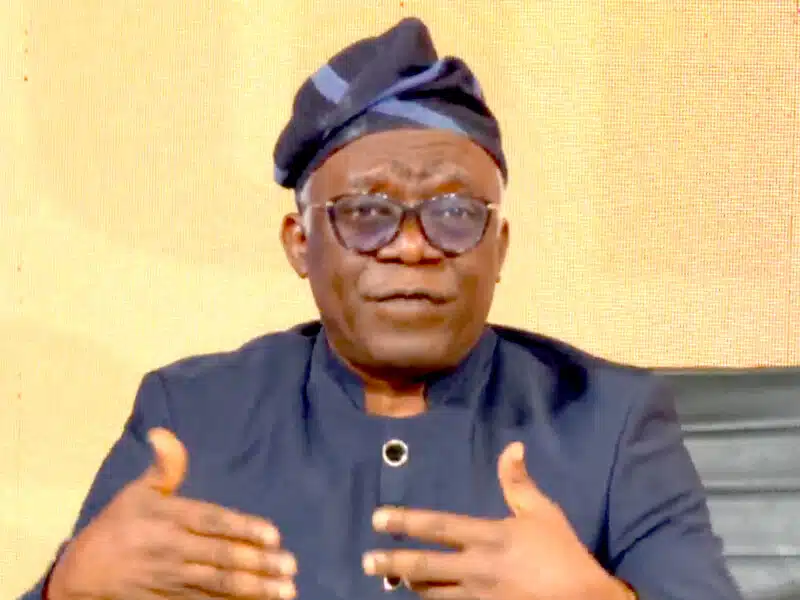
Human rights lawyer and Senior Advocate of Nigeria (SAN), Femi Falana, has condemned the alleged inclusion of a ₦1.4 billion road project in Ogun State in the 2026 budget of the National Commission for Almajiri and Out-of-School Children Education (NCAOOSCE), describing it as a clear case of budget padding.
The commission has come under scrutiny over the allocation of ₦8.4 billion for road projects in Ogun, Ekiti and Katsina states despite its mandate being limited to educational development. NCAOOSCE has denied responsibility for the projects, insisting that the National Assembly inserted the constituency projects into its budget.
Speaking at the Penpushing Media 8th Anniversary Lecture on Thursday, Falana called for an immediate review of the budget to remove what he described as illegal insertions.
According to him, lawmakers have continued the practice of adding projects unrelated to the mandates of government agencies into the national budget.
“It was recently disclosed that a road in Ogun State will be constructed with the sum of ₦1.4 billion. That is what we call budget padding. Members of the National Assembly insert projects into the budgets of government agencies,” Falana said.
He expressed hope that the exposure of the projects would lead to a comprehensive review of the budget and the removal of the disputed allocations.
Falana also criticised President Bola Tinubu for allegedly allowing such insertions to remain in the budget, arguing that the President has the constitutional authority to reject unlawful provisions before signing the appropriation bill.
“We have always tried to expose them. But it appears that the President allows it because he has the right to object to illegal insertions into the budget. These days, they are allowed,” he said.
The senior lawyer further raised concerns about persistent corruption in the country, blaming weak institutions and the absence of effective checks and balances for enabling public officials to accumulate unexplained wealth.
He warned that the full extent of corruption under any administration often becomes evident only after it leaves office.
Falana urged Nigerians to play an active role in combating corruption by reporting individuals whose lifestyles and assets appear inconsistent with their legitimate sources of income.
He encouraged citizens to submit such reports to anti-graft agencies, including the Economic and Financial Crimes Commission (EFCC) and the Independent Corrupt Practices and Other Related Offences Commission (ICPC), stressing that public vigilance remains essential in promoting accountability and good governance.