

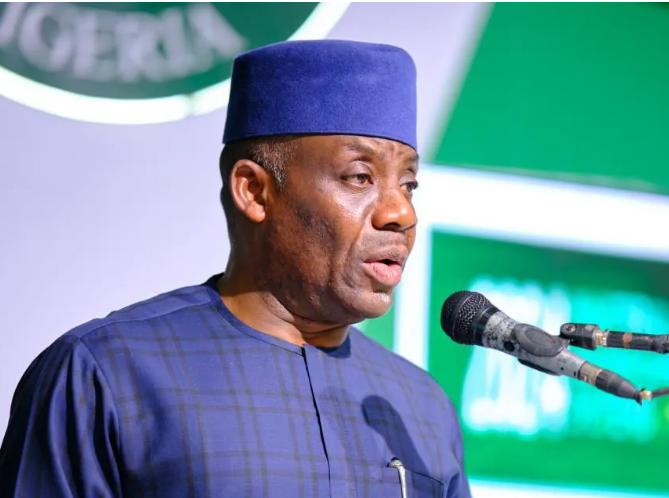
The Federal Government has reaffirmed its commitment to producing industry-ready and innovative graduates, announcing a special TETFund intervention to upgrade engineering departments in polytechnics nationwide with modern, state-of-the-art equipment.
The Minister of Education, Dr. Maruf Alausa, disclosed this on Wednesday in Abuja at a retreat for governing council chairmen, commissioners of education, rectors, registrars and bursars of polytechnics and colleges of technology.
The retreat, themed “Transforming Polytechnic Education in Nigeria: Innovation, Good Governance and Sustainability for National Development,” was organised by the Council of Heads of Polytechnics and Colleges of Technology in Nigeria (COHEADS).
Alausa said the new intervention follows similar support extended to medical colleges last year and aligns with the Federal Ministry of Education’s renewed focus on Technical and Vocational Education and Training (TVET).
“We have adopted a policy that ensures our polytechnic graduates are industry-ready, innovative problem-solvers capable of driving national development,” the minister said.
Calling for a sweeping transformation of polytechnic education, Alausa stressed that innovation, good governance and sustainability must be central to national growth.
“Polytechnics are not mere institutions; they are the crucibles where innovation meets practicality, where skills forge economic resilience, and where sustainable development becomes a lived reality,” he said.
He urged polytechnic leaders to prioritise entrepreneurship, applied research and industry partnerships, especially in key sectors such as renewable energy, agricultural technology, digital manufacturing and climate-resilient solutions.
“Innovation must be the heartbeat of our polytechnics. Foster entrepreneurship centres, research hubs and industry partnerships that turn ideas into prototypes and inventions into enterprises,” Alausa added.
The minister also warned against poor governance, insisting on transparency, accountability and ethical leadership across institutions.
“The era of impunity in our institutions is over. We demand fiscal discipline, timely audits and zero tolerance for corruption to build public trust and attract investment,” he said.
Alausa further encouraged institutions to adopt sustainable funding models through internally generated revenue (IGR) and reduced dependence on imports, while assuring stakeholders of government support under President Bola Ahmed Tinubu’s Renewed Hope Agenda.
Speaking earlier, COHEADS Chairman, Dr. Sani Tunga, described the retreat as timely, noting that polytechnics remain critical to Nigeria’s diversification and job creation drive.
“Our polytechnics stand at the forefront of producing skilled, innovative and entrepreneurial manpower needed to reduce unemployment and achieve the Sustainable Development Goals,” Tunga said.
He acknowledged challenges facing the sector, including inadequate funding, outdated infrastructure, governance gaps and recurring conflicts between governing councils, management and staff unions.
Tunga said the retreat was designed to promote dialogue, strengthen governance and explore innovative approaches to curriculum development, research, industry collaboration and financial sustainability.
In his opening remarks, Executive Secretary of the National Board for Technical Education (NBTE), Prof. Idris Bugaje, described recent reforms as a turning point for technical education in Nigeria after decades of neglect.
Bugaje noted that technical education predates university education in Nigeria but suffered years of underinvestment, adding that reforms introduced under Alausa’s leadership have begun to reposition the sector.
“NBTE is being reinvented, re-engineered and re-created, and we are beginning to see light at the end of the tunnel,” he said.
Participants were urged to return to their institutions and translate the retreat’s resolutions into concrete actions capable of repositioning polytechnic education as a cornerstone of Nigeria’s industrial and economic transformation.