
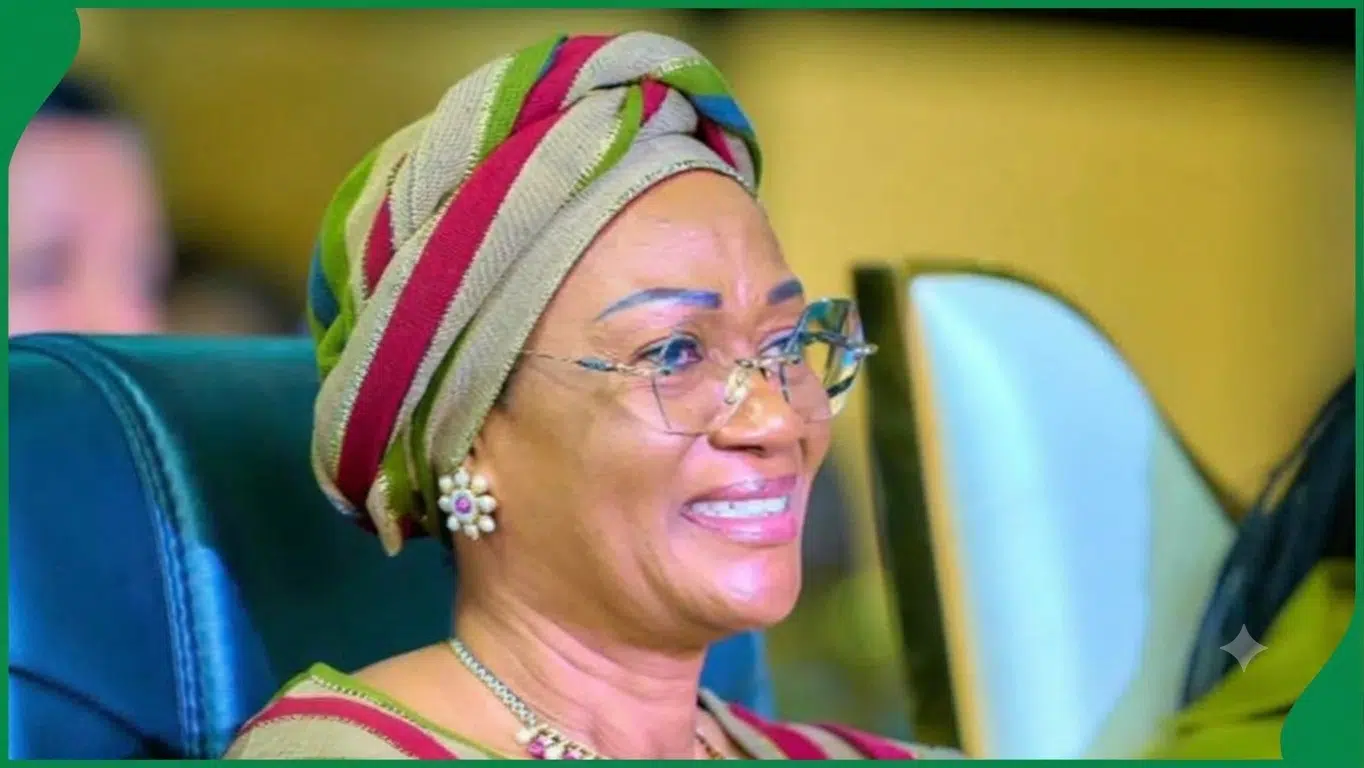
First Lady Oluremi Tinubu on Monday launched a major nationwide intervention aimed at keeping Nigerian girls in school, flagging off the distribution of two million packs of sanitary towels and essential back-to-school materials while unveiling a ₦2 billion support programme for 100,000 learners.
The event, tagged “Flow with Confidence 2.0: Keeping Every Girl in School,” took place at the State House Banquet Hall in Abuja as part of activities marking the 2026 International Day of the Girl Child. The global theme this year is “End Child Marriage and Invest in Girls’ Rights.”
Mrs Tinubu announced that under the Universal Basic Education Commission’s (UBEC) Learners Retention Support Programme, each of the 100,000 beneficiaries in the first phase will receive a ₦20,000 grant. The programme is designed to tackle both financial pressures and menstrual hygiene barriers that force many girls, especially those in rural communities, to miss classes or drop out entirely.
“Keeping our girls in school requires us to recognise and address the challenges that affect their education, especially those in rural communities, who often miss school because they do not have access to sanitary products,” the First Lady said. She linked the initiative to President Bola Tinubu’s Renewed Hope Agenda, stressing that educating girls is critical to national development.
She recalled that her Renewed Hope Initiative first launched the original Flow with Confidence programme on 2 October 2025, providing a year’s supply of disposable sanitary pads to 370,000 girls in rural areas. UBEC has now taken over and expanded the effort, pairing sanitary towels with school bags, shoes, exercise books, mathematical sets and writing materials.
Mrs Tinubu charged the wives of state governors to personally supervise distribution in their states, working with commissioners of education and chairmen of State Universal Basic Education Boards to guarantee transparency and accountability. She also appealed to traditional and religious leaders to help end the stigma around menstruation so that girls can speak openly and seek support without shame.
“I want you to grow into confident and courageous women ready to contribute meaningfully to our nation. Nigeria is counting on you and I believe in you,” she told the schoolgirls present.
Minister of Education Dr Tunji Alausa confirmed that the Federal Government is institutionalising menstrual hygiene support in public basic schools. UBEC will now make annual budgetary provisions for sanitary towels, while the World Bank-supported Adolescent Girls Initiative for Learning and Empowerment (AGILE) will provide complementary support. He noted that the first phase of the original programme successfully reached its target of 370,000 girls across the 36 states and the FCT.
Minister of State for Education Professor Suwaiba Sa’id Ahmad added: “No girl should have to choose between her education and her menstrual health.”
UBEC Executive Secretary Dr Aisha Garba highlighted the commission’s broader achievements in less than three years: construction of more than 4,000 classrooms, supply of learning materials to over three million pupils, and the return of more than 700,000 out-of-school children to classrooms. She emphasised that practical measures such as free sanitary products can prevent unnecessary absences.
Senator Umaru Tanko Al-Makura, Chairman of the UBEC Governing Board, linked school dropout directly to child marriage, stating: “Every day we keep her in the classroom is a day her childhood is protected.”
The Sultan of Sokoto, Alhaji Muhammad Sa’ad Abubakar III (represented by the Emir of Argungu), urged parents, teachers, community leaders and religious institutions to challenge practices that restrict girls’ education. He called for prompt, transparent and equitable implementation of the new programme.
Ian Attfield of the British High Commission noted that UK-supported programmes have helped more than 1.5 million additional girls access education in northern Nigeria since 2012, while the $1.2 billion AGILE programme continues to expand secondary education opportunities for girls in 21 states.
Mrs Tinubu formally inaugurated the nationwide distribution of the sanitary towels and learning materials across the 36 states and the Federal Capital Territory at the close of the event.