
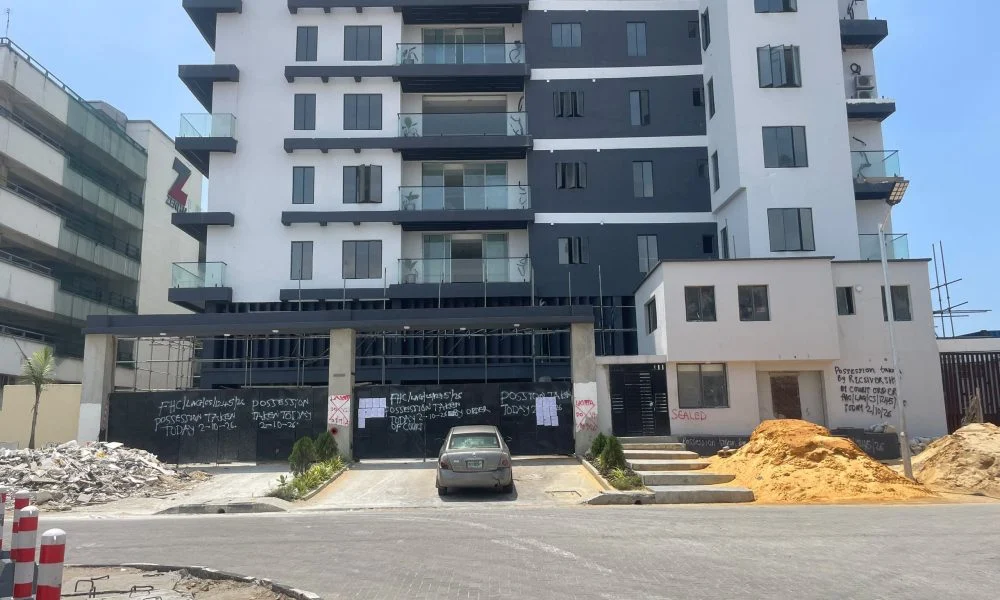
Contractual documents and recent court filings in the bitter fight over No. 68 Molade Okoya Thomas Street, Victoria Island, Lagos, appear to strongly support the original landowner’s case.
Dr (Mrs) Maryam Sani Abacha insists the prime plot was handed to Levitikal Realties & Construction Limited only for the construction of 18 three-bedroom apartments. It was never transferred as the developer’s free commercial asset.
Under the joint-venture agreement, Levitikal was to receive nine completed units as payment for its work. Mrs Abacha would keep the other nine and, once the project finished, sign Deeds of Assignment for the developer’s share. With the development now mired in dispute, any buyer of those units may have to wait for the legal dust to settle before obtaining clear title.
What has alarmed observers is the developer’s alleged attempt to stretch a limited development mandate into full ownership or unrestricted control of the underlying land itself.
The controversy intensified when Levitikal reportedly sliced the project into more than 44 units—mixing one-bedroom, two-bedroom and three-bedroom apartments—far beyond the original 18. That unilateral expansion has raised sharp questions: Who authorised the extra units? Who owns the additional interests? And under what legal power were they marketed or sold?
To keep the Abacha family in the dark, Levitikal is said to have blocked every request for access to the site despite repeated demands.
The Economic and Financial Crimes Commission is already investigating the sale of the partitioned units to third-party buyers. Earlier reports confirmed that EFCC operatives had marked the property as part of their probe.
A parallel battle is raging over Levitikal’s bid to register a Power of Attorney and use the registration as a springboard to seize the property. That suit, filed by Providus Bank Limited and Levitikal at the Lagos State High Court, originally excluded the Abacha family. Once they discovered it, the court ordered their joinder.
On 29 September 2026, Justice Ambrose Lewis-Allagoa of the Federal High Court, Lagos, appointed a receiver/manager to take immediate possession, custody and control of the property. The judge also restrained Levitikal, its directors, agents and anyone acting for them from selling, transferring, assigning, mortgaging, leasing or otherwise encumbering the asset pending the outcome of arbitration.
Although interim, the order is a decisive move to freeze the status quo and protect the disputed land while the core issues are resolved.
At the heart of the drama lies a simple contractual question: Did the original agreement hand Levitikal ownership of the land, or merely the right to develop it under strict terms?
If the bargain was for 18 units with nine going to the developer as consideration, any later expansion and creation of extra proprietary interests would need clear contractual backing.
For now, the available evidence leans heavily toward Mrs Abacha’s position that she remained the owner of the land and that Levitikal’s role was a defined development arrangement—not an open-ended transfer of control.
The case carries wider implications for Nigeria’s real-estate sector, especially the precise rights granted to developers under joint-venture agreements. Any purchaser who has already bought a unit is advised to monitor the proceedings closely; the final outcome could determine whether their interest survives.