
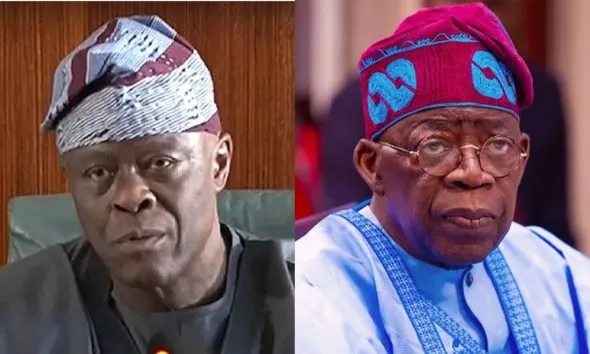
President Bola Ahmed Tinubu’s decision to remove Wale Edun as Minister of Finance and appoint Taiwo Oyedele as his replacement has triggered mixed reactions across Nigeria’s economic landscape.
The announcement, made Tuesday in a memo issued by George Akume, also confirmed the removal of Ahmed Muda Dangiwa, who was directed to hand over to Muttaqha Rabe Darma as minister-designate.
While the Presidency did not provide specific reasons for the shake-up, it emphasized that the move aligns with the President’s constitutional authority. Still, the sudden nature of the decision has stirred debate among economists, investors, and policy watchers.
Edun, who played a central role in advancing the administration’s “Renewed Hope” agenda, oversaw major reforms including fuel subsidy removal and exchange rate liberalization. He had previously pointed to improvements in key indicators, noting that Nigeria’s GDP growth rose to 4.07 percent in the fourth quarter of 2025, while inflation declined from over 22 percent to around 15 percent.
Despite these gains, many Nigerians continue to grapple with high living costs, particularly in food, transport, and energy, raising questions about the real impact of the reforms on households.
The timing of Edun’s exit has also drawn attention. It comes shortly after the International Monetary Fund downgraded Nigeria’s growth forecast to 4.1 percent, citing global economic pressures, including geopolitical tensions in the Middle East. Edun had only recently returned from the IMF/World Bank Spring Meetings in Washington, where he reiterated that Nigeria would not seek a bailout and assured policy stability.
Market reactions were swift but mixed. The naira weakened to N1,350.74 per dollar, reflecting investor uncertainty, while trading on the Nigerian Exchange Limited still posted a modest gain of N88 billion—significantly lower than the previous day’s N609 billion rally.
Experts say the long-term impact of the leadership change will depend less on personalities and more on policy direction. Speaking on the development, a professor of accounting and finance, Godwin Oyedokun, described the reshuffle as a double-edged sword.
According to him, while such moves can signal a government’s willingness to recalibrate strategy and inject fresh momentum into economic management, they can also unsettle markets if not clearly communicated.
“Investors are primarily concerned with policy coherence, predictability, and credibility,” Oyedokun noted, adding that abrupt or poorly explained decisions risk creating uncertainty.
He stressed that maintaining consistent economic policies, strengthening institutions, and ensuring transparency would be critical in reassuring both local and foreign investors.
As Taiwo Oyedele steps into the finance portfolio, attention is expected to shift quickly to how the new leadership will sustain reforms, address inflationary pressures, and stabilize investor confidence in Africa’s largest economy.